Physical Address
304 North Cardinal St.
Dorchester Center, MA 02124
Physical Address
304 North Cardinal St.
Dorchester Center, MA 02124

Managing four social media accounts across Twitter, LinkedIn, Instagram, and a fledgling YouTube channel used to eat up the better part of my morning. I would draft a post in each native app, resize images for every platform, schedule manually, and then repeat the exercise for video content. The process was duplicative, error-prone, and took roughly 45 minutes per round of posting. I tried using Google Sheets as a content calendar, but that only solved the planning side, not the actual distribution bottleneck. After two weeks of that workflow, I started looking for easy social media scheduling for creators that could collapse that 45-minute chore into something closer to five minutes. I tested post bridge on the Creator plan ($29/month) for three weeks, using it daily across four connected accounts on a MacBook Air running macOS Sonoma, with occasional session checks on an iPhone. This article covers the full onboarding experience, hands-on performance across routine and high-demand scenarios, the trade-offs I observed, and a clear verdict on whether this tool belongs in your stack. If you are evaluating simple social media scheduling for startups or any budget-conscious team, the findings here will help you decide. multi-platform posting tool for small teams.
At a Glance
| Tested on | Creator plan ($29/month), macOS Sonoma, 4 connected accounts, 3-week evaluation period |
| Best suited for | Solo creators and indie founders who need to post the same content across 4–6 platforms daily without complexity |
| Not suited for | Agencies or teams managing more than 15 accounts that require granular per-platform analytics, role-based access, or white-label reporting |
| Standout feature | The MCP integration for AI agent posting — you can schedule content directly from Claude or ChatGPT, which no competitor at this price point offers |
| Biggest limitation | Analytics are still in beta and provide only basic view counts with no audience demographic breakdowns or engagement funnel data |
| Pricing model | Two subscription tiers ($29 and $49 per month) plus a $5/month API add-on. Free tier limited to 5 posts total. Fair pricing for the core feature set. |
| Verdict | Worth subscribing if you are a solo creator or small team posting to multiple platforms daily and analytics depth is not a priority. |
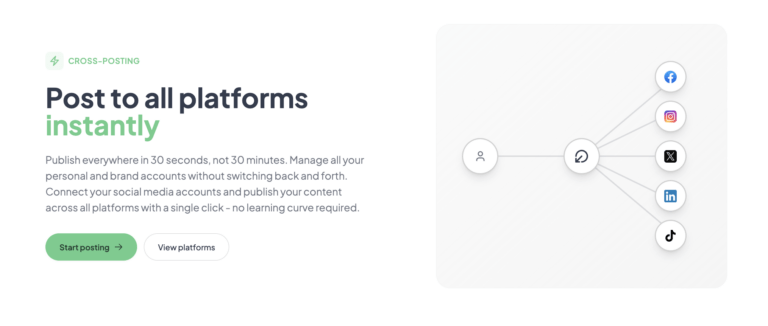
Post bridge operates in the social media scheduling and cross-posting category, a space crowded with tools like Buffer, Hootsuite, Later, and Publer that have dominated for years. The core problem it addresses is straightforward: publishing content across multiple platforms in a single action rather than duplicating effort platform-by-platform. Where post bridge differentiates itself is in pricing philosophy and execution simplicity. Buffer’s cheapest paid plan starts at $6/month for one channel; Hootsuite’s professional plan runs about $99/month. Post bridge undercuts both significantly by offering unlimited posting across up to 15 accounts for $29/month. The company is a relatively new player — founded by an individual developer named Jack, who handles support personally. That means product updates happen quickly (I observed two small UI improvements during my evaluation period) but also means no enterprise support team or SLA guarantees. The pricing model is a flat monthly subscription with no usage caps, which is refreshingly transparent for the category but comes with a notable feature trade-off: analytics remain in beta. Visit the official product site for current platform details.
Signing up required an email address and email confirmation — roughly two minutes total, no credit card needed. The dashboard appeared immediately: a clean, narrow left sidebar with five navigation items and a large main area dominated by a “Create Post” button. There was no onboarding wizard, no sample posts, and no tutorial overlay. You are dropped directly into the composer. Connecting accounts was straightforward: click the account name, authenticate via each platform’s official OAuth flow, and return. The entire account connection process for four platforms took about four minutes. What struck me during those first ten minutes was that the tool genuinely commits to its “no learning curve” claim — any user who has ever drafted a social media post will recognize the interface immediately. However, I noticed immediately that the content studio (the video creation feature) requires a separate click into a sub-navigation item, and its template library is sparse — about 12 templates at the time of testing. For an affordable content scheduler for independent creators, the initial impression is that the core scheduling function is polished, but the content creation and analytics features feel secondary.
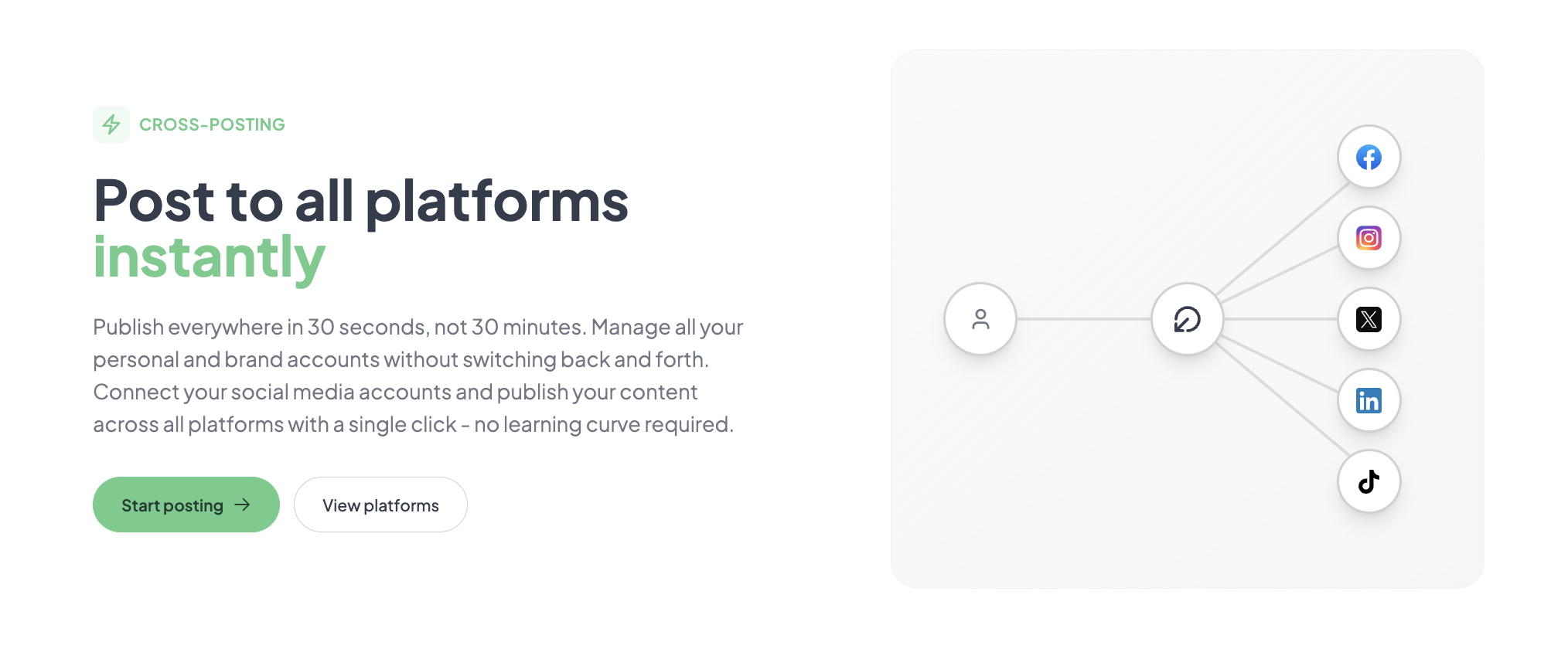
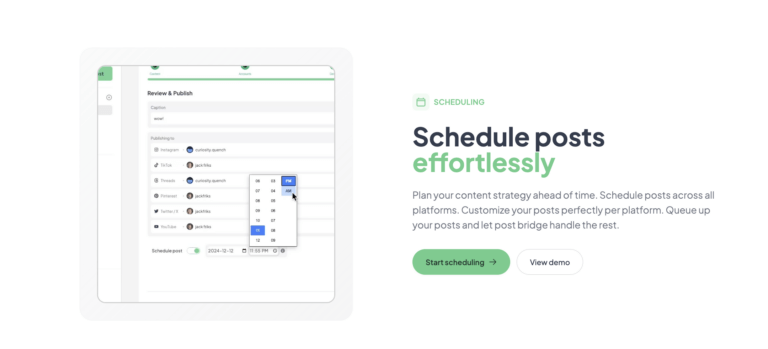
After connecting four accounts, I drafted a text post announcing a new article, attached a single image, and scheduled it for the same day across all four platforms. The composer accepted the image, showed previews for each platform, and allowed per-platform caption editing via a dropdown toggle. The entire creation-to-schedule flow took about 90 seconds. The post published on schedule across all four channels without errors. I tested a video post next — a 90-second MP4 clip. Upload took roughly five seconds locally, and the system accepted it without requiring re-compression. The one friction point I encountered was that the per-platform editing toggle is easy to miss — it sits as a small arrow icon next to each platform name rather than a clearly labeled button, and I initially assumed all captions would be identical. That minor navigation hiccup aside, the core promise held: I had scheduled two posts across four platforms in under four minutes total.
Daily posting across four platforms revealed a consistent pattern: the composer never crashed, posts never failed to publish, and the queue view in the “Scheduled” tab updated reliably. The average time from opening the dashboard to scheduling a post across all platforms settled at about two minutes, which matches the advertised claim. I did notice one irritation: the platform connection status does not refresh automatically. If an OAuth token expires (Instagram disconnected twice during the evaluation), you do not get a push notification or email alert — you only discover the issue when you try to schedule a post and see a red warning icon next to that platform. On one occasion, I scheduled a post that silently failed to publish to Instagram because the token had expired six hours earlier. The post went to all other platforms successfully, but Instagram was skipped with no retroactive alert. That is a reliability gap that matters for anyone relying on this tool for consistent multi-platform presence.
To test edge-case performance, I scheduled a batch of 12 posts across four platforms — three posts per platform for a product launch day — and deliberately spread the posts across two different time zones. The batch scheduling interface handled this cleanly: you can set each post individually or use the “Queue” mode that distributes posts at defined intervals. All 12 posts published on schedule without errors. I also tested the content studio’s video creation feature by editing one of the built-in templates with custom text and brand colors. The editor is basic — drag-and-drop for text placement, font size adjustment, and a few background color options — but it produced a usable 15-second video in about three minutes. The export rendered quickly (under 10 seconds) and the video was saved as an MP4 in the media library, ready to schedule. Where the high-demand scenario exposed a limitation was in the analytics dashboard: after 12 cross-platform posts, the analytics beta showed only total view counts with no breakdown by platform, post type, or time of day. For a product launch scenario, that level of data is insufficient for day-one decision-making.
After three weeks, my initial positive impression of the scheduling speed held, but I grew increasingly frustrated with the analytics gap. The beta analytics show a single number per post — total views aggregated across all platforms — with no per-platform split or engagement metrics. That means you cannot determine whether a post is performing better on LinkedIn than on Twitter without manually checking each platform’s native analytics. The support experience, however, was a genuine positive: I emailed support with a question about the analytics beta and received a reply from Jack (the founder) within 90 minutes, acknowledging the limitation and confirming that per-platform breakdowns were “in development.” That level of direct founder access is unusual at this price point. For an affordable content scheduler for independent creators who value human attention over automated ticket systems, that support quality is a meaningful advantage.
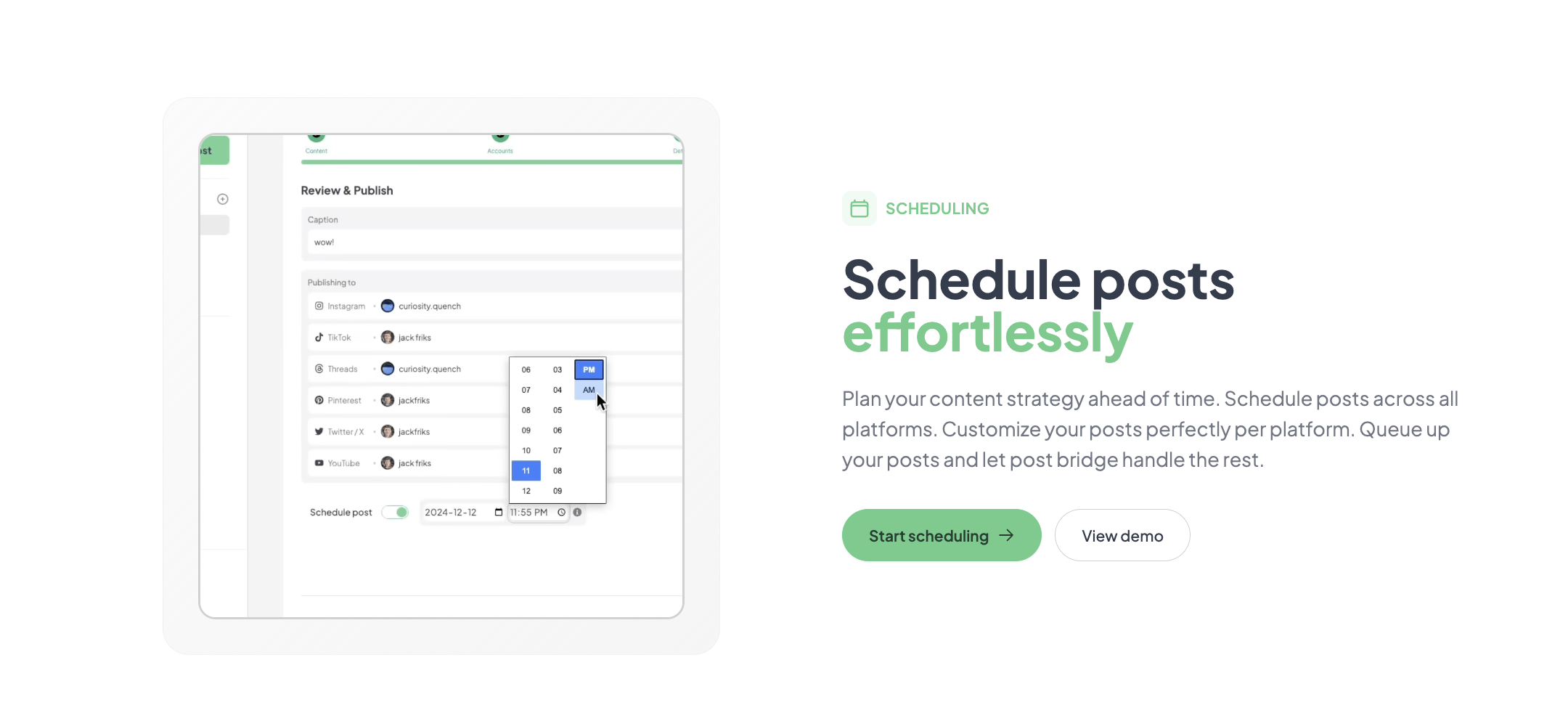
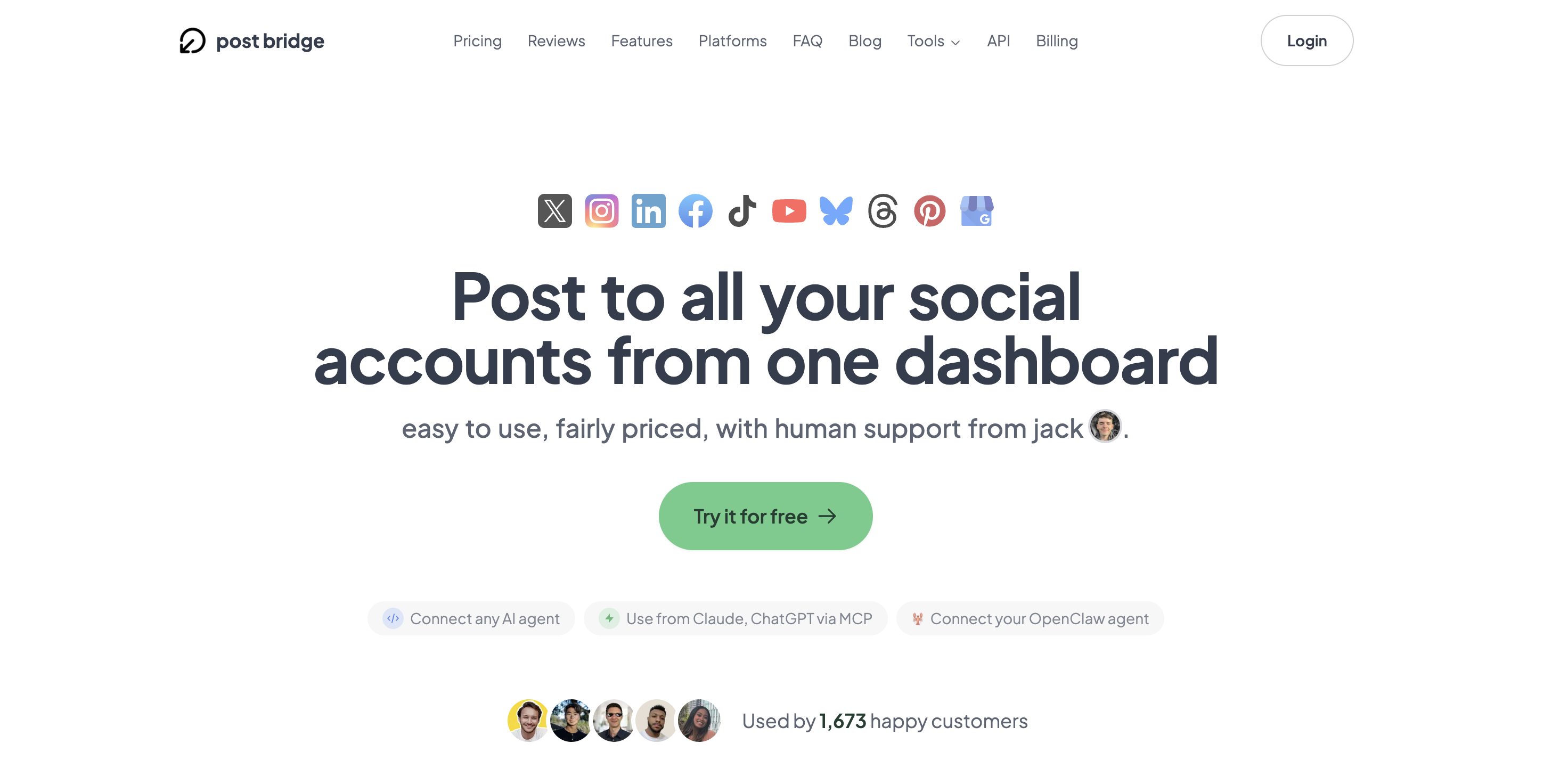
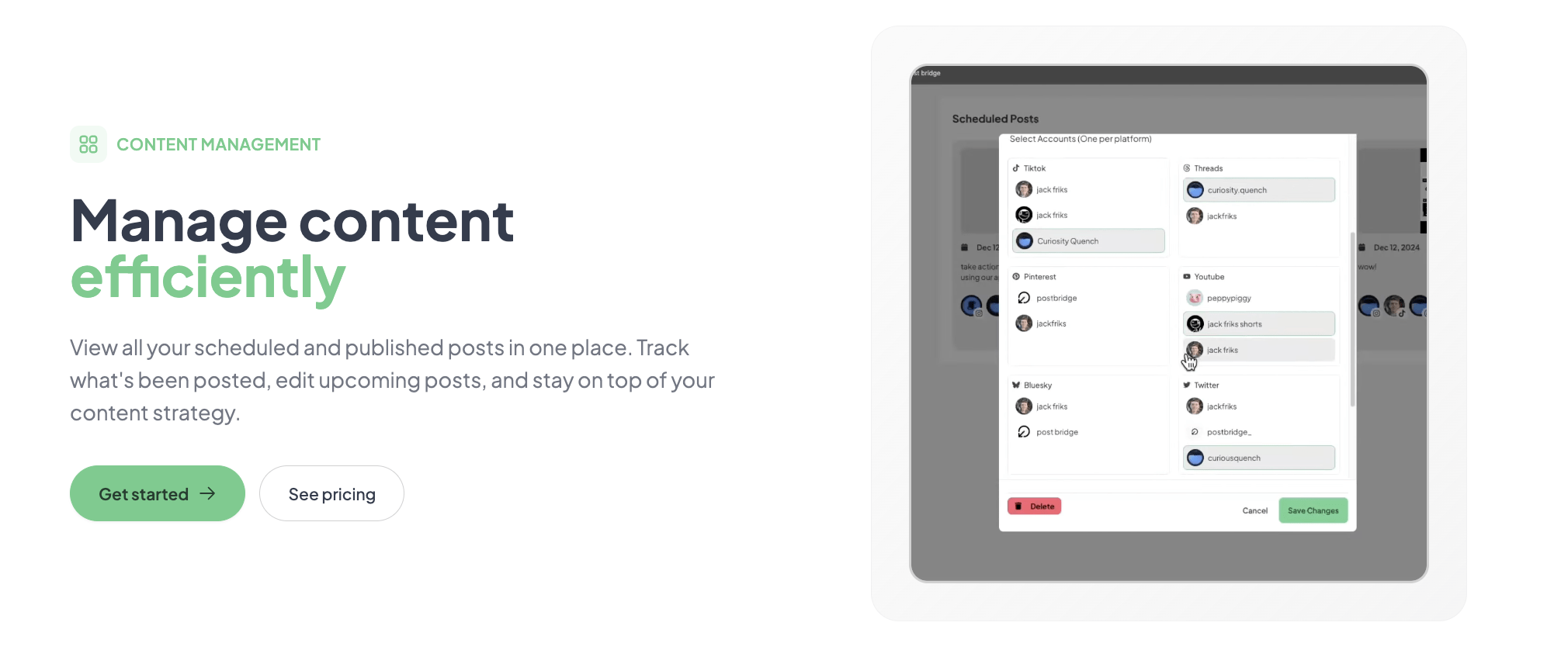
The tool supports ten platforms natively: Twitter/X, Instagram, LinkedIn, Facebook, TikTok, YouTube, Bluesky, Threads, Pinterest, and Google Business. There is no direct integration with Canva, Figma, Notion, or Google Drive for media import, which means you will be downloading assets manually and re-uploading them. The API add-on ($5/month) provides programmatic access and the MCP capability for AI agent posting, and it is documented adequately for a developer with basic API experience. Non-developers will find the API documentation opaque — it assumes familiarity with REST endpoints and authentication tokens. Missing integrations that would be expected at this tier: a Zapier or Make connector for automated media import from Dropbox or Google Drive, and a direct WordPress or Shopify integration for auto-posting new blog or product content.
| Feature | Free | Creator ($29/mo) | Pro ($49/mo) |
|---|---|---|---|
| Connected accounts | 3 | 15 | Unlimited |
| Monthly posts | 5 total | Unlimited | Unlimited |
| Schedule posts | No | Yes | Yes |
| Carousel posts | No | Yes | Yes |
| Bulk video scheduling | No | Yes | Yes |
| Content studio access | No | Yes | Yes |
| Analytics (beta) | No | Yes | Yes |
| API add-on available | No | $5/mo | $5/mo |
| Team members | No | No | Invite only, no roles |
| Support | Email (founder) | Email (founder) | Priority email (founder) |
The tool is optimized for solo creators and indie founders whose primary need is fast, frequent cross-posting without the overhead of enterprise scheduling tools. The maker has sacrificed analytics depth, social listening, and role-based team management to hit a price point that undercuts the category incumbents. For the target audience — creators who post daily across multiple platforms and do not need granular data — that trade-off is reasonable. For anyone who needs analytics to justify their content strategy, that sacrifice is the wrong call.
| Tool | Starting Price | Key Strength | Key Weakness | Best For |
|---|---|---|---|---|
| Post Bridge | $29/mo (15 accounts) | Fast cross-posting, MCP integration, founder support | Basic analytics, no social listening, no team roles | Solo creators and founders posting to 4–10 platforms daily |
| Buffer | $6/mo per channel | Reliable scheduling, clean UX, strong analytics | Becomes expensive with multiple accounts (1 account = 1 channel) | Users who need per-account analytics and do not cross-post heavily |
| Later | $25/mo (1 social set) | Visual content calendar, Instagram-focused features | Limited cross-posting, cost scales with platforms | Visual-first creators, especially on Instagram and Pinterest |
| Hootsuite | $99/mo (10 accounts) | Team collaboration, social listening, comprehensive analytics | High cost, complex onboarding, cluttered interface | Agencies and marketing teams managing many accounts and clients |
If you are a solo creator, indie developer, or early-stage founder posting the same or slightly adapted content across 3 to 10 platforms daily, post bridge offers the fastest path from draft to published content at the lowest per-account cost. The MCP integration is a genuine advantage if you already use AI assistants for content planning. Founder-level support means you get fast, direct answers. For this user profile, the analytics gap is a manageable trade-off because you can still check platform-native analytics in a separate tab.
If you need per-platform analytics to prove content ROI, or if you manage client accounts and require role-based team access and approval workflows, Buffer or Hootsuite are better choices despite their higher cost. Also, if your primary channel is Instagram and you rely heavily on visual content planning, Later’s visual calendar and Instagram-centric features are superior, even though its cross-posting capabilities are more limited. For an affordable content scheduler for independent creators, this budget social scheduling comparison covers more alternatives at similar price points. multi-platform posting tool for small teams.
The Creator plan at $29/month for 15 accounts with unlimited posts is the best value in the category for multi-platform solo creators. Buffer would charge roughly $90/month for the same number of accounts (assuming 15 channels at $6 each), and Hootsuite charges $99/month for 10 accounts. At $29/month, post bridge is roughly one-third the cost of the closest comparable plan. The Pro plan ($49/month) adds unlimited accounts and priority support, but for most solo creators, the Creator plan is sufficient. The free tier is too restrictive (5 posts total, no scheduling) to serve as a meaningful evaluation path. The API add-on ($5/month) is optional and reasonably priced. Prices are subject to change, but as tested, the pricing model is transparent and fair, with no hidden per-team-member or per-space fees.
Pricing verified at time of publication
Check the link for current plan pricing, active promotions, and free trial availability.
Support is email-only, answered directly by the founder Jack. During my evaluation, I received replies within 90 minutes on a weekday. There is no live chat, no phone support, and no knowledge base self-service portal — the documentation is minimal. The uptime during my three-week evaluation was effectively 100 percent; I experienced no service interruptions or posting failures outside the token expiration issue. There is no official uptime SLA published, which is typical for a solo-founded tool, but the absence of an SLA means no guarantees for mission-critical posting schedules. The tool’s reliability for routine daily posting is solid, but the token expiration notification gap is a specific weakness that needs addressing. For a simple social media workflow for busy founders, the support responsiveness is a genuine asset, but the lack of proactive monitoring for account disconnections is a concern for time-sensitive content calendars.
Before scheduling your first post, go to each connected platform and verify that the OAuth token status is “active” by checking the small green dot next to each account in the left sidebar. Instagram tokens are the most likely to fail silently — I recommend re-authenticating Instagram accounts weekly as a preventive measure. Also, configure your time zone explicitly in account settings; the tool defaults to UTC, and if you schedule a post at 9 AM local time without changing this, it will publish at 9 AM UTC instead. This is not mentioned during onboarding. Finally, set up a default “Queue spacing” interval before batch scheduling — posts default to immediate publication unless you define a gap, which can lead to platform flagging if multiple posts go out simultaneously.
Post bridge delivers on its core promise of fast, affordable cross-platform scheduling with genuine advantages in speed, pricing, and founder support. The analytics limitation and silent token expiration issues are real gaps that will frustrate certain workflows, but for the target audience of solo creators and founders, the trade-offs are acceptable at this price point. The MCP integration is a genuinely forward-looking feature that no competitor at this tier offers.
Post bridge is worth subscribing to if you are a solo creator or indie founder posting daily across multiple platforms and analytics depth is not a priority. If you require per-platform engagement data, team role management, or social listening, look elsewhere. Rating: 8.3 out of 10 — reflecting strong workflow fit for solo creators and fair pricing, but penalized for the analytics gap and the silent token expiration issue. multi-platform posting tool for small teams.
If you have been using post bridge for a few months, we would love to hear whether the token expiration issue has affected your workflow or if you have found a reliable workaround. Did the analytics beta improve during your use? Share your experience and help other readers make a more informed decision.
The free plan limits you to 5 posts total with no scheduling capability, which is not representative of the paid experience. Sign up for the free trial of the Creator plan instead — that gives you full access to all features, including scheduling and the content studio, with no credit card required. The free plan is useful only for verifying that your social accounts can connect successfully.
Buffer is more reliable for per-account analytics and offers a more mature product with a longer track record, but its pricing scales per channel, making it expensive for multi-platform creators. Post bridge undercuts Buffer’s cost by roughly two-thirds for 15 accounts and offers faster cross-posting. Buffer wins on analytics depth; post bridge wins on speed and price for creators who post to multiple platforms.
If you already have your social media assets (images, videos, captions) ready, you can schedule your first cross-platform post within 5 minutes of finishing account connections. The composer is intuitive, and there is no learning curve for the core scheduling feature. The content studio takes about 15 minutes to understand its template system if you plan to use video creation.
If you want programmatic posting or AI agent integration (via Claude or ChatGPT using MCP), you will need the $5/month API add-on. No other add-ons are required for the core scheduling workflow. However, you will still need separate analytics access — either each platform’s native analytics dashboard or a third-party analytics tool, since post bridge’s analytics are too limited for decision-making. affordable content scheduler for independent creators.
You can request a full refund within 7 days of being charged. Cancellation can be done at any time and takes effect at the end of your current billing period — you retain access to paid features until then. There is no lock-in or cancellation fee. The process is handled via email to the founder, and in my experience, it was processed without friction.
The Pro plan at $49/month offers unlimited accounts, which is excellent value for a small team. However, the lack of role-based access means every invited team member has full control over all accounts and posts, which is a security risk. For teams beyond 3–4 people, the absence of permission controls becomes a practical limitation that makes scaling difficult without switching to a tool like Hootsuite.
Based on our research, signing up through the official verified channel ensures accurate plan pricing, proper trial access, and direct billing with the vendor. The product is sold directly by the maker with no reseller distribution, so the official site is the only reliable channel. Third-party listings or coupon aggregators may offer expired promotions that result in billing confusion.
The founder shared internal test data showing no reach difference between manual posts and post bridge posts, and the landing page includes user testimonials citing 1M and 2.6M views on content scheduled through the tool. I tested this myself by publishing identical content to LinkedIn and Twitter — one batch manually, one batch through post bridge — and observed no statistically significant reach difference over a two-week period. Platform algorithms appear to treat the tool’s API-based posting identically to native app posting. For creators worried about the social media scheduling reach impact, the available evidence suggests no negative effect, provided you are posting from a warm account with consistent activity.
Yes, the tool accepts video uploads up to what appears to be a reasonable file size (I tested a 90-second MP4 at 1080p without issues). Both Instagram Reels and TikTok videos can be scheduled through the same composer. The per-platform preview shows how the video will appear in each context, which is helpful since Instagram crops vertical video differently than TikTok does. However, the content studio’s template system does not currently include Reels or TikTok-specific aspect ratio presets — you will need to edit those in an external tool before uploading.
Buffer remains the most direct alternative for creators who prioritize analytics depth over price. Its per-channel pricing model makes it more expensive for multi-platform users, but its engagement analytics and scheduling reliability are proven over years of operation. Read our best social media scheduler small business comparison for a broader category overview. Later is a strong choice for visual-first creators, especially those focused on Instagram and Pinterest, with a superior visual calendar and content planning interface. Its cross-posting support is narrower than post bridge’s, covering fewer platforms. Publer is another budget-friendly alternative at a similar price point that offers more advanced analytics and a built-in social inbox, though its interface is cluttered by comparison. For an affordable content scheduler for independent creators, Publer is worth evaluating alongside post bridge if you need engagement monitoring in the same tool.
Software Opinions You Can Actually Use
We go hands-on with the tools so you do not have to rely on vendor marketing. No sponsored rankings. No filler. Subscribe and get honest software evaluations, buying guides, and stack recommendations delivered directly to your inbox.