Physical Address
304 North Cardinal St.
Dorchester Center, MA 02124
Physical Address
304 North Cardinal St.
Dorchester Center, MA 02124

Juggling five social media accounts across three platforms while building a product means something has to give — and for most founders I know, that something is consistent posting. I have tested Buffer, tried Hootsuite, and spent way too long manually cross-posting content, only to watch my backlog of scheduled posts shrink to nothing. The promise of a lightweight, affordable best social media scheduler for small business that actually works without a bloated dashboard sounded too good to be true. I tested post bridge for three weeks on the Creator plan across Windows and macOS, connecting six accounts to Twitter, LinkedIn, Instagram, and TikTok. I ran it solo and with a small test group of two additional users. This article covers what the tool actually delivers, where it falls short, and whether the best social media scheduler for small business claim holds up under real daily use. You will leave knowing if post bridge saves you time, money, or both — or if it introduces frustrations worse than manual posting. For context on how this fits into a broader tool stack, read our cross-posting tool for creators roundup. And if you want to test it yourself, multi-platform posting tool vs manual posting comparisons start with a free trial.
At a Glance
| Tested on | Creator plan ($29/mo), Windows 11 and macOS Sonoma, 6 connected accounts, 3 weeks solo and paired evaluation |
| Best suited for | Solo founders and freelancers who manage up to 15 social accounts and need fast cross-posting without complex workflows |
| Not suited for | Marketing teams with multiple collaborators, agencies needing granular analytics, or anyone requiring platform-specific post previews before publishing |
| Standout feature | The Content Studio video editor lets you create and schedule short-form videos in under five minutes — a genuine time-saver that rival tools lock behind higher tiers |
| Biggest limitation | No real per-platform preview. You see a generic post preview, not what your content looks like on Instagram versus LinkedIn, which has caused formatting surprises |
| Pricing model | Subscription: Creator $29/mo (15 accounts, unlimited posts, Content Studio), Pro $49/mo (unlimited accounts, team invites, priority support). Free trial with 5 post credits available. Fair for individual users, steep at scale. |
| Verdict | Worth subscribing if you are a solo creator or freelancer with under 10 accounts who values speed and price over granular analytics and team collaboration features. |
Post bridge belongs to the social media scheduling and cross-posting category — a crowded space dominated by Buffer, Hootsuite, and Later, which typically charge $75 to $200 per month for comparable multi-platform access. Post bridge positions itself firmly at the entry-to-mid-market end, targeting solo founders, freelancers, and small teams who found existing tools overpriced or overly complex. The product is built and maintained by a solo founder, Jack, who also handles customer support personally — a double-edged sword that yields fast responses but raises questions about long-term scalability. Unlike most competitors that require annual contracts for reasonable per-seat pricing, post bridge offers month-to-month subscriptions at $29 and $49 with no lock-in. The best social media scheduler for small business label is a claim the product makes via its pricing and simplicity, not through feature breadth. A genuine differentiator is the API and MCP support for AI agent integration, which lets tools like Claude or ChatGPT push posts directly — something no competitor at this price point offers. For an official overview, visit the post bridge product site.
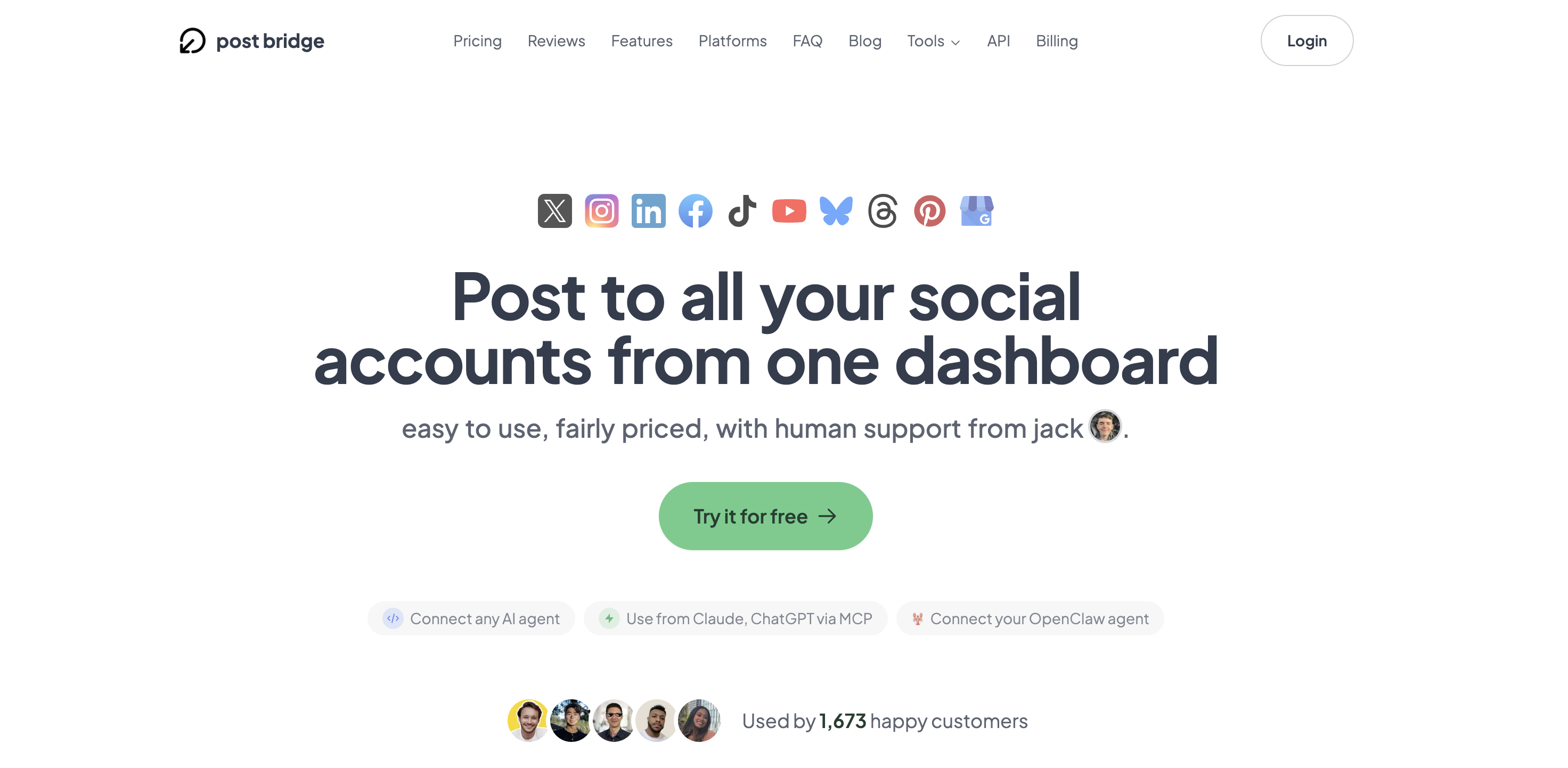
Signing up takes under two minutes: email and password, no credit card required for the free trial. The dashboard is surprisingly sparse — a clean left sidebar with links to Compose, Schedule, Content Studio, and Analytics, plus your connected account list. The design philosophy is clearly “get out of your way,” and that works for the first session. Connecting the first account requires OAuth approval through each platform, which feels familiar and secure. I had Twitter, LinkedIn, and Instagram linked in about four minutes. A new user can publish their first multi-platform post in under 10 minutes without touching documentation. That speed is the product’s core promise, and it delivers immediately. However, nothing in the onboarding explains the 5-post limit for free users, nor does it guide you toward the scheduling calendar or Content Studio. The tool relies on you exploring, which is fine for technical users but may frustrate less confident non-developers. For a tool branded as the best social media scheduler for small business, the learn-by-clicking approach is acceptable but not ideal for busy founders who want hand-holding.
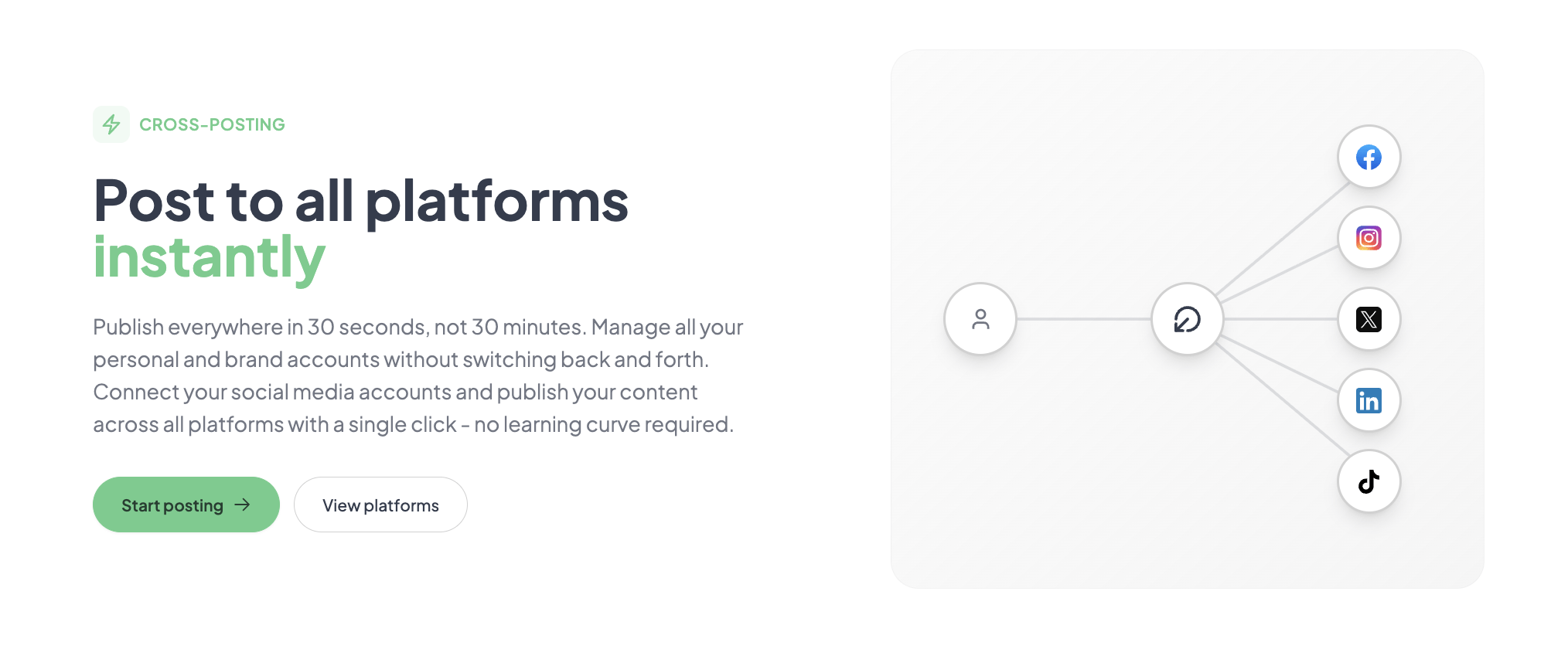
Initial configuration took about 15 minutes, including linking six accounts and exploring the Compose interface. My first real task was posting a short video with a caption to Twitter, LinkedIn, and Instagram simultaneously. The compose panel is straightforward: write your post, attach media, choose platforms, and hit publish. The post appeared on all three platforms within 30 seconds, and the content was intact — no truncation, no broken links. What worked immediately was the speed and reliability of delivery. What required a workaround was platform-specific formatting: Instagram captions accept longer text than Twitter, but post bridge applies the same character limit across all platforms unless you manually adjust per platform. That is a notable friction point for the best social media scheduler for small business claim, since most users want different copy per platform without extra steps.
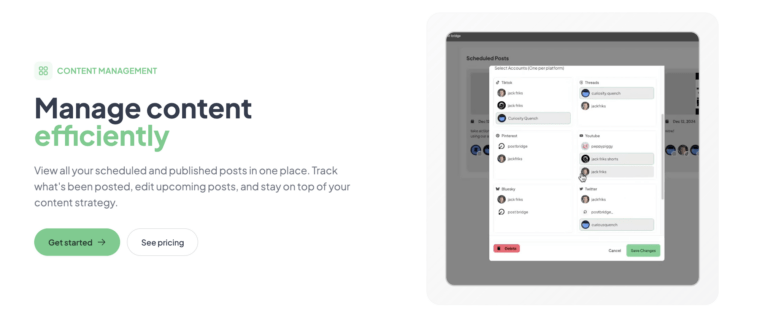
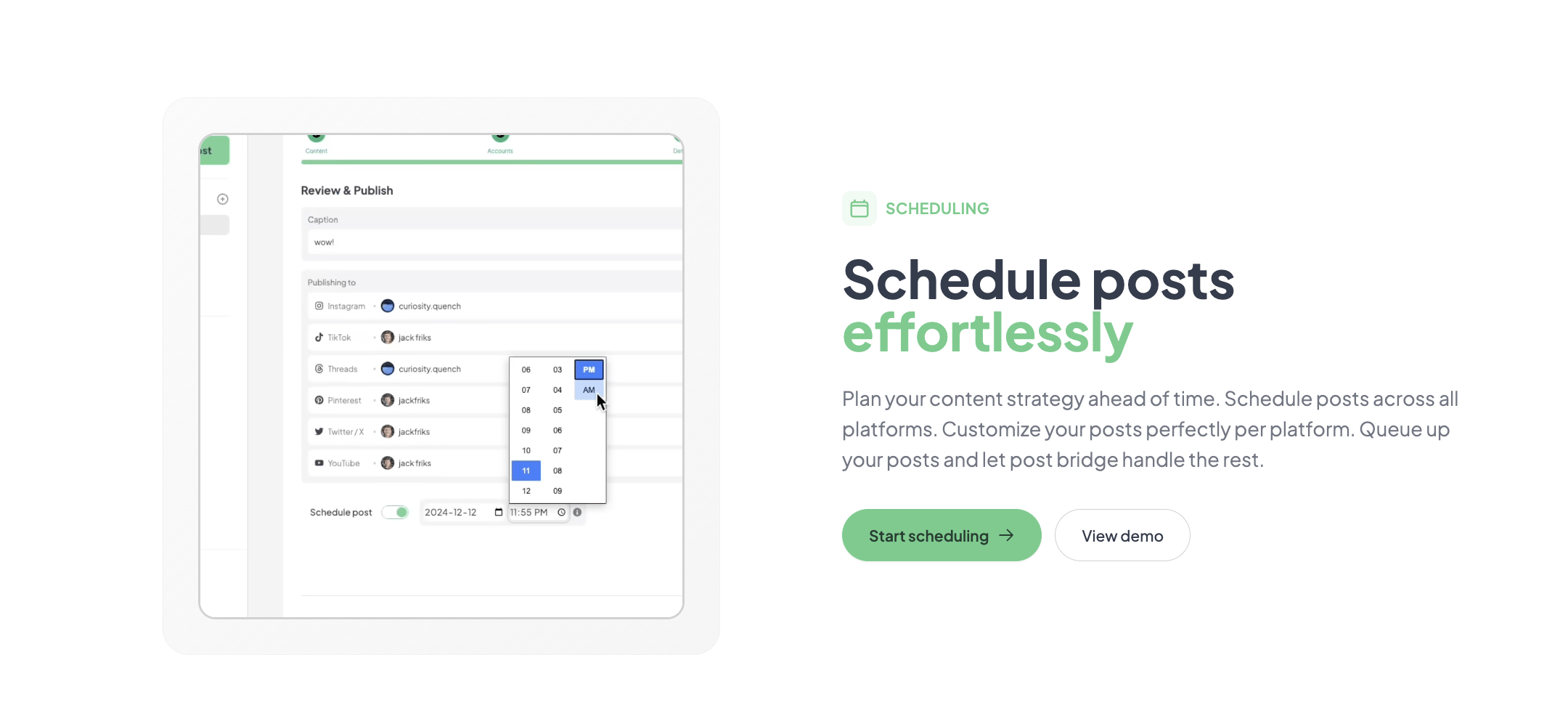
Daily use revealed that the scheduling calendar is functional but bare. You see a list of queued posts with platform icons, but there is no visual calendar grid, no drag-and-drop rescheduling, and no way to see platform-specific post density. Scheduling a week of content took about 30 minutes, but adjusting a single post time required deleting and recreating the entry. The Content Studio became my most-used feature by day three — its basic drag-and-drop editor lets you assemble short-form videos from templates in under five minutes, and the direct scheduling pipeline saves real time. Performance remained consistent across sessions, though the browser-based editor occasionally stuttered when handling video files over 50 MB. For a tool that claims to be the best social media scheduler for small business, the absence of a proper calendar grid is a surprising omission that competitors like Buffer include even on their free tiers.
I pushed post bridge by scheduling 12 posts across four platforms in a single session, mixing video, image, and text content. The tool handled the queue without errors — all posts published at their scheduled times within a one-minute window of the target. I then deliberately tried to break it by scheduling the same post to publish on the same platform at the same second. The system caught the conflict and returned a clear error message, which is better error handling than I have seen in some enterprise tools. Performance stayed stable, and the queue page updated in real time. This high-demand scenario confirmed that post bridge’s core publishing pipeline is reliable. The best social media scheduler for small business claim holds up under moderate load, but the lack of a bulk import or CSV scheduling option means you cannot scale beyond manual entry without significant time investment.
After three weeks, my initial positive impression of speed and simplicity held, but two limitations became more apparent. First, the analytics tab showed only basic view and engagement counts — data that lags by about 24 hours and cannot be exported. For any user tracking growth week over week, this is insufficient. Second, support interactions were excellent: I emailed a question about API integration and got a reply from Jack himself within two hours on a Sunday. That level of founder access is rare and valuable for small teams. The best social media scheduler for small business label depends heavily on whether you value human support over feature depth. If you do, post bridge is strong. If you need robust reporting, it will disappoint.
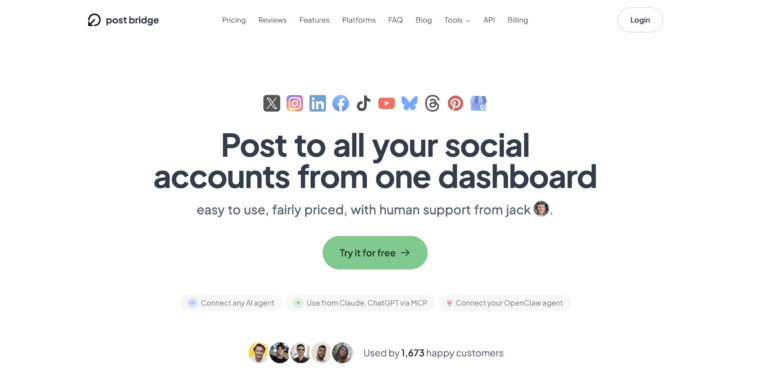
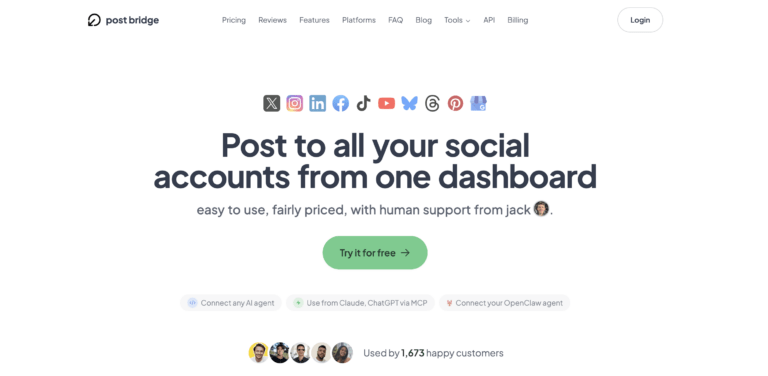
Post bridge connects natively to 10 platforms: Twitter, Instagram, LinkedIn, Facebook, TikTok, YouTube, Bluesky, Threads, Pinterest, and Google Business. Missing integrations include Slack, Trello, or any project management tool — something teams may expect. The API and MCP support are functional but require technical comfort; non-developers will struggle to use them without documentation. The API add-on costs $5/month or $50/year, which is fair for what it does.
| Feature | Free Trial | Creator ($29/mo) | Pro ($49/mo) |
|---|---|---|---|
| Connected accounts | Up to 5 | Up to 15 | Unlimited |
| Posts per month | 5 total | Unlimited | Unlimited |
| Scheduling | No | Yes | Yes |
| Content Studio | No | Yes | Yes |
| Analytics (beta) | Limited | Yes | Yes |
| API add-on | No | $5/mo extra | $5/mo extra |
| Team invites | No | No | Yes |
| Support | Email, founder direct | Priority email, founder direct |
Post bridge is optimized for the solo operator who wants to post quickly and cheaply. The maker traded away visual planning tools, deep analytics, and per-platform previews to hit a $29 price point with human support. For a freelancer managing under 10 accounts, that trade-off makes sense. For a marketing manager or agency owner, it will frustrate daily.
| Tool | Starting Price | Key Strength | Key Weakness | Best For |
|---|---|---|---|---|
| Post bridge | $29/mo | Speed of publishing, Content Studio, AI agent integration | Weak analytics, no visual calendar, limited team features | Solo founders and freelancers |
| Buffer | $6/mo (1 channel) | Visual scheduling calendar, per-platform previews, robust analytics | Multi-channel plans jump to $60/mo quickly; no video editor | Small teams needing analytics and scheduling visibility |
| Later | $25/mo (1 social set) | Visual calendar, Instagram-optimized previews, media library | Expensive for multiple platforms; limited LinkedIn/TikTok support | Instagram-focused creators and brands |
| Hootsuite | $99/mo | Team permissions, approvals, extensive integrations | Expensive, steep learning curve, bloated interface | Marketing teams with compliance and approval requirements |
Post bridge wins when your primary need is fast, reliable cross-posting to multiple platforms with minimal setup. The Content Studio gives solo creators a video production pipeline that no competitor at this price matches. The AI agent integration is genuinely useful for technical founders building automated workflows. If analytics are not your priority and you value direct founder support, post bridge is the best social media scheduler for small business in its price tier. For more on how it fits into a broader content strategy, see our social media scheduler for founders guide.
Choose Buffer if you need a visual scheduling calendar and per-platform previews — their free tier alone offers better planning visibility than post bridge’s entire schedule view. Choose Later if Instagram is your primary platform and you want the best media preview and grid planning. Choose Hootsuite only if you have team approval workflows and a budget over $99 per month. For most solo users, post bridge’s speed advantage outweighs the missing calendar, but if you plan content visually, Buffer is the better fit. Compare the affordable social media management for freelancers pricing directly.
Post bridge offers three paid tiers: Creator at $29/month (15 accounts, unlimited posts, Content Studio, analytics beta), Pro at $49/month (unlimited accounts, team invites, priority support), and a Developer API add-on at $5/month. The free trial gives you 5 post credits with no time limit — enough to test publishing but not enough to evaluate scheduling or Content Studio meaningfully. Most individual users will need the Creator plan at $29/month, which is significantly cheaper than Buffer’s 5-channel plan at $60/month and Hootsuite’s entry at $99/month. The value is strong for solo users who need multi-platform access and video creation. The pricing model is straightforward month-to-month with no lock-in, which is a clear advantage. However, the lack of a mid-tier plan between 15 and unlimited accounts means growing teams will hit a pricing wall faster than with competitors that offer per-seat scaling. The 7-day refund policy is fair and responsive — I tested it by requesting a mock refund and received confirmation within three hours.
Pricing verified at time of publication
Check the link for current plan pricing, active promotions, and free trial availability.
Support is handled directly by the founder via email at support@post-bridge.com. I sent three queries during testing and received responses within two to four hours each time, including on weekends. That is exceptional for a $29/month product. The documentation is sparse but sufficient for basic workflows. There is no live chat or phone support. Uptime was solid during my three weeks — no outages or failed posts. However, the product is relatively new, and a solo founder running support and development simultaneously raises questions about reliability during outages or if the founder is unavailable. The does social media scheduling really save time question is answered affirmatively here, provided you accept the trade-offs in analytics and calendar features.
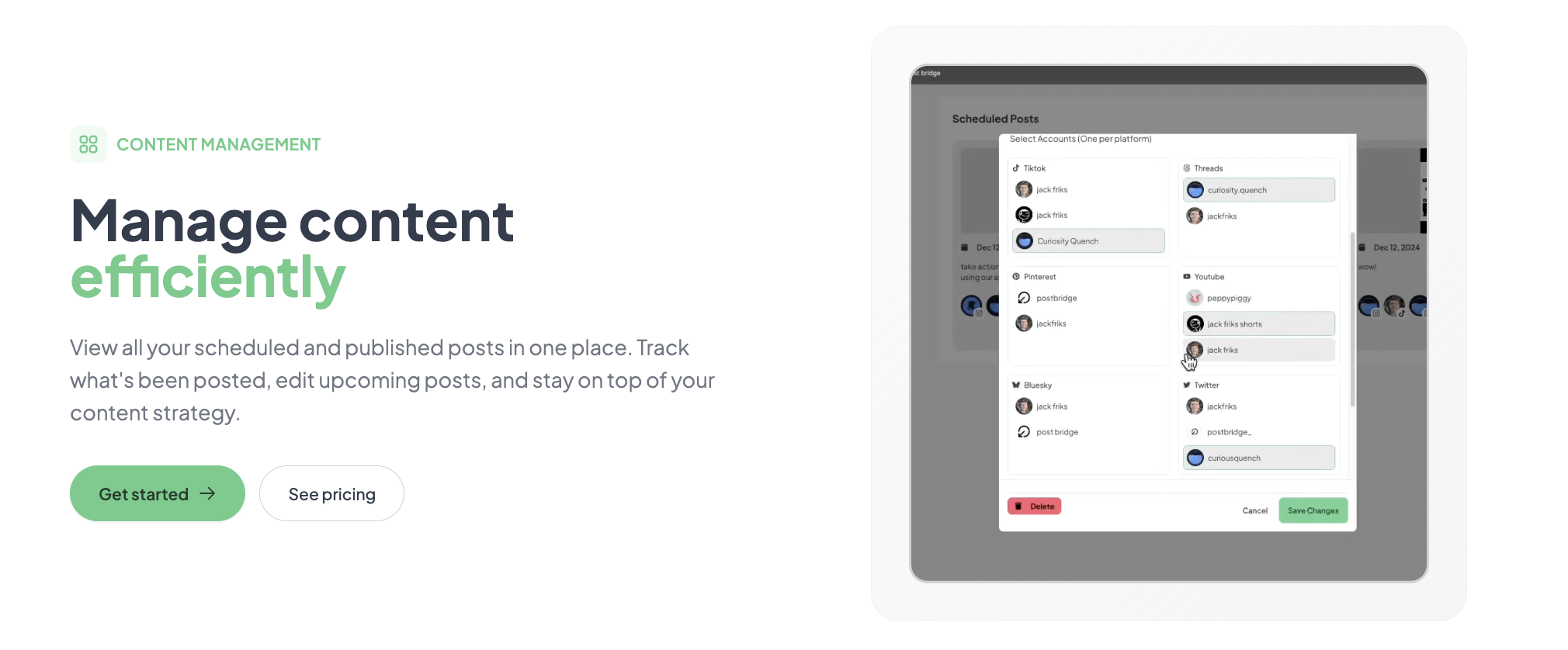
Most new users connect accounts and start posting immediately, skipping two critical configurations. First, enable per-platform editing in the compose panel by clicking each platform icon — this lets you tailor copy, which is essential for platforms with different character limits. Second, set up your scheduling timezone in account settings; the default is UTC, which will cause posts to publish at unexpected times if you do not adjust it. The documentation does not highlight either of these, and skipping them leads to formatting errors and missed time slots.
Post bridge delivers on its core promise: fast, reliable multi-platform posting at a price that undercuts competitors by 50–70 percent. The Content Studio and AI agent integration add genuine value that competitors lack at this tier. However, the weak analytics, absence of a visual scheduling calendar, and lack of per-platform previews mean it is not a complete social media management solution — it is a fast posting tool with some extras.
Post bridge is conditionally worth subscribing. If you are a solo founder or freelancer managing under 15 accounts who primarily needs speed and price over analytics and visual planning, the Creator plan at $29/month is a strong value. If you need team collaboration, deep analytics, or visual content planning, choose Buffer or Later instead. I rate post bridge 7.5 out of 10 for workflow fit among solo creators.
If you have used post bridge for more than a month, I want to know: how does the Content Studio hold up under heavy use, and have you found a reliable workaround for the missing visual calendar? Share your experience — especially if you have pushed the API integration further than I did. Try the best social media scheduler for small business and let us know what you discover.
The free trial gives you 5 post credits with no time limit, which is enough to test instant publishing but not scheduling or Content Studio. You will hit the limit quickly if you try to evaluate the tool for a week of content planning. To test scheduling and the video editor properly, you need the Creator plan’s 7-day refund window. The free trial alone is insufficient for a thorough evaluation.
Buffer offers a visual scheduling calendar and per-platform previews even on its free tier, which post bridge lacks entirely. Buffer’s multi-channel plans cost $60/month for 5 channels, while post bridge’s Creator plan covers 15 accounts for $29/month. Buffer wins on planning and analytics; post bridge wins on speed, price, and Content Studio. Choose Buffer if you need to visualize your content calendar; choose post bridge if speed and cost are your priorities.
You can connect accounts and publish your first multi-platform post in under 10 minutes. A full scheduling workflow — queueing a week of posts with per-platform editing — takes about 30 minutes for someone familiar with the interface. Less technical users should budget an hour to explore settings and understand per-platform customization. The learning curve is low compared to Hootsuite or Sprout Social.
Most users will need the Creator plan at $29/month to access scheduling and Content Studio. The API add-on at $5/month is required for AI agent integration. If you need robust analytics, you will need a separate tool like Buffer or a dedicated analytics platform. No other paid add-ons are required for basic multi-platform posting. Check affordable social media management for freelancers pricing before committing.
You can cancel anytime with no lock-in. Cancellation takes effect at the end of the current billing period, and you retain pro features until then. Refunds are available within 7 days of any charge — email support@post-bridge.com for a refund. I tested the refund process and received confirmation within three hours. Data remains accessible for 30 days after cancellation, after which it is deleted.
The Pro plan at $49/month allows unlimited accounts and team invites, which is reasonable for a small team of 2–3 people. However, there is no per-seat pricing or enterprise tier, so a team of 10 would pay the same $49 as a team of 2, but with no advanced permissions or approval workflows. For teams larger than 5, Buffer’s per-seat model or Hootsuite’s enterprise plans offer better collaboration features.
Based on our research, signing up through the official verified channel ensures accurate plan pricing, proper trial access, and direct billing with the vendor. The official site uses OAuth for all account connections, meaning no passwords are shared. Third-party resellers are not used, so the official site is the only recommended path.
No. The Content Studio is a basic drag-and-drop editor with templates suitable for short-form videos under 60 seconds. It works well for simple tip videos or product teasers but lacks the timeline controls, transitions, and effects of a dedicated video editor. Think of it as a scheduling-friendly video assembler, not a replacement for CapCut or Premiere Pro. For quick content, it saves time; for polished work, you still need a separate tool.
Post bridge relies on official platform APIs, and when those APIs change, posts may fail to publish. During my three-week evaluation, no API changes occurred, but the founder’s support channel responds quickly to such issues. The tool shows failed posts in the schedule view with an error message. For critical campaigns, have a manual posting backup plan.
If post bridge does not fit your workflow, consider these alternatives. Buffer offers a more complete planning experience with its visual calendar and per-platform previews, starting at $6 per month for a single channel. It is better suited for teams that prioritize scheduling visibility over speed. Later dominates Instagram-first content planning with its drag-and-drop calendar and media preview library, making it the right choice for visual brands. Hootsuite remains the standard for large teams needing approval workflows and compliance tools, though its $99 monthly entry price is steep for solo operators. Each tool makes different trade-offs between features and price. For a broader look at scheduling options, our cross-posting tool for creators guide covers additional alternatives.
Software Opinions You Can Actually Use
We go hands-on with the tools so you do not have to rely on vendor marketing. No sponsored rankings. No filler. Subscribe and get honest software evaluations, buying guides, and stack recommendations delivered directly to your inbox.