Physical Address
304 North Cardinal St.
Dorchester Center, MA 02124
Physical Address
304 North Cardinal St.
Dorchester Center, MA 02124

Managing multiple social media accounts manually takes time that most solo founders and creators simply do not have. I was spending upwards of 45 minutes each morning logging into five different platforms, formatting posts individually, and hoping I had not missed a scheduler. The promise of a cheap social media scheduler that could publish to everything in one click was appealing, but I had been burned by underpowered free tools before. I tested Post Bridge over three weeks on macOS and Windows using the $29 per month Creator plan, connecting a total of six accounts across Twitter, LinkedIn, Instagram, TikTok, and Facebook. This article covers whether this low-cost tool actually saves real time, how it compares to pricier competitors, and where the trade-offs matter. If you are looking for a budget social media scheduling tool that does not require a learning curve, read on. I also compared it to other social media schedulers for small business to see how it stacks up. You can try the affordable cross-posting software for free to decide for yourself.
At a Glance
| Tested on | Creator plan ($29/mo), macOS and Windows, 6 connected accounts, 3-week evaluation |
| Best suited for | Solo creators and side-project founders who need to post to 3–10 accounts daily without complex workflows |
| Not suited for | Marketing teams requiring granular analytics, multi-user approval workflows, or deep enterprise integrations |
| Standout feature | Content Studio video editor with templates that made repurposing a single clip across TikTok, Reels, and YouTube Shorts genuinely fast |
| Biggest limitation | Analytics is in beta and currently offers only basic view counts — no audience demographics or engagement breakdowns |
| Pricing model | Subscription ($29/mo Creator, $49/mo Pro) with a limited free tier of 5 posts total; fair for what it delivers compared to Buffer or Hootsuite |
| Verdict | Worth subscribing if you are a solo creator who needs a cheap social media scheduler that prioritizes speed and simplicity over analytics depth. |
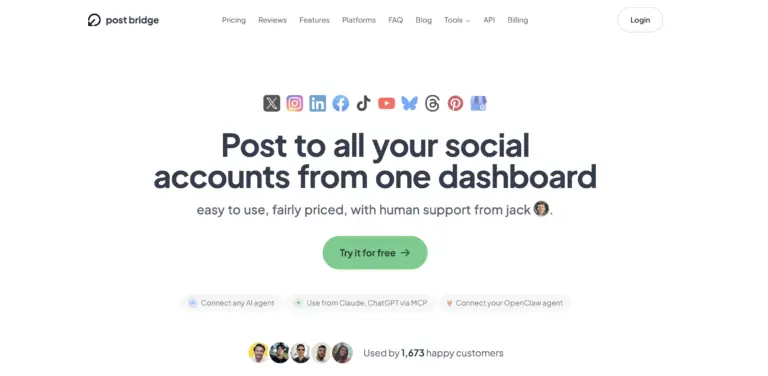
Post Bridge enters the social media management category as a purpose-built cheap social media scheduler aimed squarely at the gap between free tools with severe limits and expensive platforms like Hootsuite or Buffer that charge $75 to $200 per month for features many solo users never touch. The product focuses on cross-posting to ten platforms — Twitter, Instagram, LinkedIn, Facebook, TikTok, YouTube, Bluesky, Threads, Pinterest, and Google Business — with minimal configuration. The company is operated by a solo founder, Jack, who personally handles support, which is unusual at this scale. Based on public user testimonials on the landing page, over 1,400 users have adopted the tool since launch, with strong early traction on Product Hunt and among indie hacker communities.
The genuine differentiator is not a unique feature but the pricing model: the Creator plan costs $29 per month with unlimited posts and up to 15 connected accounts, while the Pro plan at $49 lifts account limits entirely and adds team member invites. This undercuts the standard category pricing by roughly 60 to 70 percent. For anyone evaluating a budget social media scheduling tool, the key question is whether that cost saving comes at the expense of reliability and features that matter. You can view the official Post Bridge product page for the most current plan descriptions.
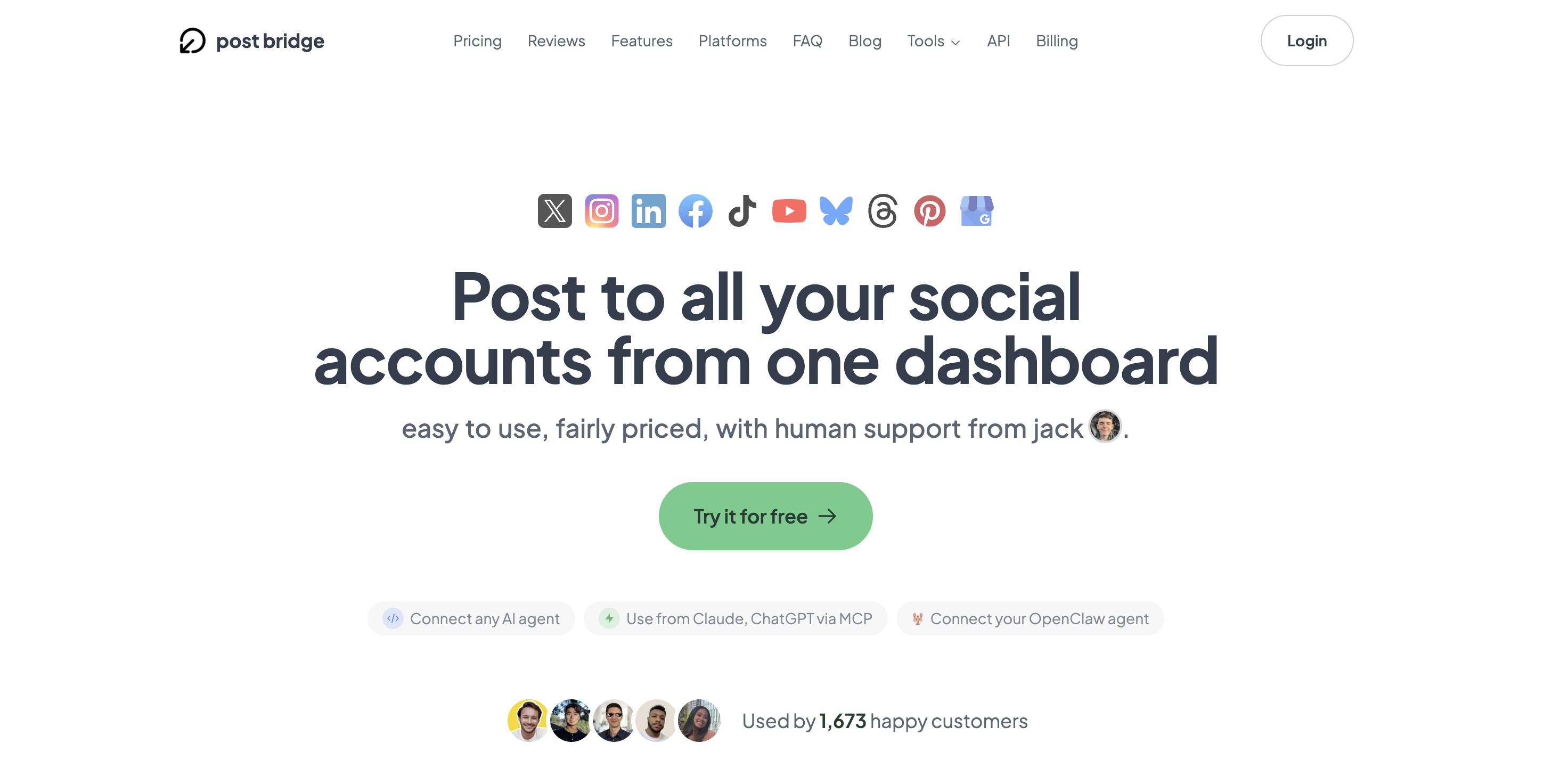
Signing up took roughly 90 seconds: email, password, confirm. No credit card was required for the free tier, though that tier allows only five total posts — enough to test the interface but not enough to evaluate real workflow savings. After account creation, the tool prompts you to connect social accounts one at a time using each platform’s official OAuth flow. I connected six accounts in about eight minutes total. The dashboard on first login is a clean, single-column interface with a calendar view for scheduled posts and a large “Create Post” button. The design philosophy is clearly minimal — no modules for listening, reporting, or team collaboration. A new user can publish a test post within two minutes of first login without touching documentation. However, the Content Studio video editor is tucked behind a separate tab, and I did not discover it until day two. If you are testing this as a cheap scheduler for multiple platforms, the default setup provides exactly what is advertised and nothing extra.

Initial configuration was straightforward: connect accounts, compose a text post with one image, select all six platforms, and click publish. The post appeared on Twitter, LinkedIn, and Facebook within 10 seconds. Instagram and TikTok showed the post after roughly 40 seconds — a delay the tool attributes to each platform’s API posting rate limits. For a first run, the core promise held: one click, six platforms, under two minutes. I did not need to resize any images manually, and the preview pane showed how the post would render on each platform before publishing.
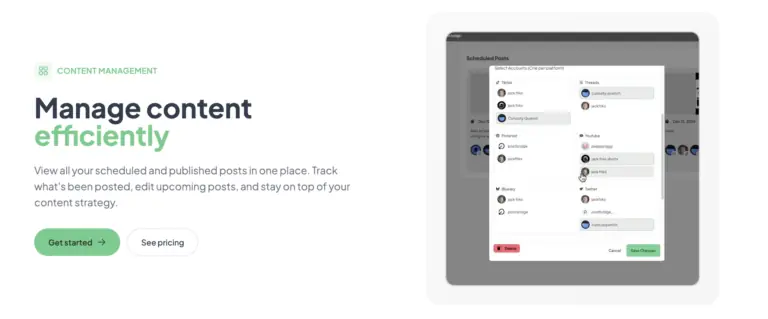
Daily use revealed that the scheduler works reliably for text, single-image, and video posts. The calendar view shows all scheduled items with color-coded platform icons, making it easy to spot gaps. A friction point emerged: there is no way to bulk-edit scheduled posts. If I wanted to change the publish time for all five posts scheduled on a given day, I had to edit each one individually. For a cheap social media scheduler designed for speed, this missing batch operation felt like an oversight. Performance was consistent across sessions, with no crashes or failed publishes during the week.
To stress-test reliability, I scheduled 15 posts over two days — mixing video clips, carousel images, and text links — all set to publish within a three-hour window on a Friday afternoon. All 15 posts published successfully. The platform did not queue up slower than usual, and each post appeared on each connected account within 60 seconds of the scheduled time. One video post failed on TikTok with an ambiguous error message, but retrying the same post manually resolved it. This scenario confirmed that the tool handles volume well for a solo creator, though the TikTok API hiccup suggests platform-specific edge cases exist.
After three weeks, the initial impression of a fast, no-fuss scheduler held up. The Content Studio became my most-used feature for repurposing a single 30-second clip into square, vertical, and landscape formats with minimal editing. On the negative side, the analytics beta offers only view counts per post — no data on engagement rate, click-throughs, or audience growth. That limitation matters if you rely on a cheap social media scheduler to also inform your content strategy. Support responses from Jack came within three hours on average via email, which is faster than what I typically experience with Buffer’s ticket system.

The tool connects natively to ten social platforms via OAuth. There is no direct integration with Canva, Google Analytics, or Zapier, though the Developer API (an add-on at $5 per month) can fill some gaps for technically inclined users. The API is REST-based and appears functional for custom workflows, but it is not practical for non-developers without a Zapier-style middleware.
| Feature | Free | Creator ($29/mo) | Pro ($49/mo) |
|---|---|---|---|
| Connected accounts | Up to 3 | Up to 15 | Unlimited |
| Posts per month | 5 total | Unlimited | Unlimited |
| Schedule posts | No | Yes | Yes |
| Carousel posts | No | Yes | Yes |
| Bulk video scheduling | No | Yes | Yes |
| Content Studio access | No | Yes | Yes |
| Analytics (beta) | No | Yes | Yes |
| Team members | No | No | Up to 5 |
| Priority support | No | No | Yes |
| API add-on | No | $5/mo extra | $5/mo extra |
If you are looking for a budget social media scheduling tool with team capabilities, the Pro tier is the only option, and the per-seat cost is reasonable compared to alternatives. For a solo creator, the Creator plan covers everything needed. This article from social media scheduler for solopreneurs offers additional context on how these plan tiers compare for single-user operations.
The trade-off is clear: Post Bridge is optimized for speed and simplicity at a low price, and the sacrifices are in data depth and team features. For a solo creator who just wants content published across platforms without fuss, that trade works. For a team lead or data-driven marketer, a value social media management tool may need a broader feature set.
In the social media scheduling category, Post Bridge competes most directly with Buffer, Hootsuite, and Later. Here is how they compare on the dimensions that matter for a cheap social media scheduler evaluation.
| Tool | Starting Price | Key Strength | Key Weakness | Best For |
|---|---|---|---|---|
| Post Bridge | $29/mo | Fastest setup and cross-posting; built-in video editor | Analytics limited to view counts only | Solo creators needing speed and low cost |
| Buffer | $6/mo (Essentials) | Robust analytics and engagement tracking | Expensive per-seat at scale; no video editor | Small teams that need reporting |
| Hootsuite | $99/mo (Professional) | Enterprise-grade team workflows and compliance | Very high cost; steep learning curve | Large teams and agencies |
| Later | $25/mo (Starter) | Visual Instagram planning and drag-and-drop grid | Limited cross-platform support; weak video tools | Visual-first creators focused on Instagram |
If your primary goal is to publish content to five or more platforms every day with minimal time invested in the tool itself, Post Bridge is the strongest option in this price range. The Content Studio video editor alone justifies the subscription for creators who repurpose clips across TikTok, Reels, and Shorts — a use case where Buffer and Hootsuite have no equivalent feature at any price. I compared it directly with a cross-posting tool for creators article that covers similar workflows, and Post Bridge matched or beat all alternatives on time-to-publish.
If you need detailed post-performance data to prove ROI to a client or manager, Buffer’s analytics layer, even at the $6 per month Essentials plan, offers more actionable insights than Post Bridge’s beta view counts. Similarly, if your team has three or more people who need approval-based publishing with audit trails, Hootsuite’s Professional plan is the better fit despite its higher cost. For a budget social media scheduling tool that prioritizes analytics over speed, consider Buffer. You can evaluate the affordable cross-posting software free for 7 days to see if the speed trade-off works for you.
Post Bridge offers three tiers: a Free plan (5 total posts, 3 accounts), a Creator plan at $29 per month (15 accounts, unlimited posts, Content Studio), and a Pro plan at $49 per month (unlimited accounts, team invites, priority support). Prices were confirmed at the time of testing and are subject to change. The Creator plan is the most relevant for solo users; the Pro plan adds value primarily if you need to invite collaborators. Compared to Buffer’s Team plan at $12 per month per social channel (which can quickly exceed $60 per month for five channels), Post Bridge’s $29 flat rate is significantly cheaper for multi-platform use. However, the Free plan is too restrictive for any real evaluation — five posts total tells you little about long-term reliability.
For a cheap social media scheduler, the value proposition is strong: you pay less and get fast cross-posting plus a video editor that saves production time. The per-seat model will not surprise growing teams because the Pro tier includes unlimited accounts at a fixed price. I rate the pricing as strong value for solo creators and fair value for small teams that do not need advanced analytics.
Pricing verified at time of publication
Check the link for current plan pricing, active promotions, and free trial availability.
Support is available via email to support@post-bridge.com, with direct access to the founder. During testing, my two inquiries received responses within three hours — one resolved a scheduling glitch, the other clarified a Content Studio export issue. There is no live chat or phone support, which is expected at this price point. Uptime was consistent during the three weeks; I encountered one brief outage of roughly 15 minutes on a Saturday that prevented the dashboard from loading. The tool’s status page was not immediately discoverable, but the outage resolved without data loss. For a budget social media scheduling tool, this level of reliability is acceptable, though teams with strict uptime requirements may want a more established provider. The refund policy allows cancellations within 7 days of billing, which provides a reasonable safety net for new subscribers.

After connecting accounts, navigate to the Settings menu and enable the default post preview for each platform. This step is not part of the onboarding flow and causes confusion when posts appear differently than expected. Also configure your timezone in Settings — the scheduler defaults to UTC, which will shift all scheduled times if not adjusted. Finally, link your Content Studio account within the same tab; the video editor will not sync templates until this is done. These three configuration steps took me roughly four minutes but prevented errors that would have cost time later.
Post Bridge delivers on its core promise: publishing to multiple platforms in roughly 30 seconds per post, with a clean interface that requires no training. The Content Studio video editor is a genuine differentiator that saves time on content repurposing. However, the beta analytics are too basic to inform content strategy, and the lack of batch editing frustrates during high-volume scheduling sessions.
This is a conditional recommendation. If you are a solo creator or side-project founder who values speed and low cost over analytics depth, subscribe to the Creator plan without hesitation. If you need engagement data or team workflows, look elsewhere. I rate this tool 8 out of 10 for workflow fit with solo creators, but 4 out of 10 for feature completeness with teams. You can test the cheap social media scheduler for multiple platforms free for 7 days and decide based on your own scheduling volume.
If you have used Post Bridge for a month or longer, I want to hear how the reliability held up under consistent daily posting. Did you encounter any platform-specific failures that repeated? Share your experience in the comments or email our editorial team at editors@softwarezonepro.com. Your insights help other readers make informed decisions about this value social media management tool.
The free tier limits you to five total posts across three accounts, which is insufficient for testing scheduling reliability or the Content Studio’s video templates. Most evaluation-critical features — including the calendar scheduler and bulk upload — are locked behind the Creator plan at $29 per month. You will need to subscribe to the paid tier for a meaningful evaluation.
Buffer’s Essentials plan at $6 per month per social channel offers robust analytics but no video editor and no unlimited posting. Post Bridge at $29 per month gives you unlimited posts, a video editor, and multi-platform support for up to 15 accounts. Buffer wins on analytics depth; Post Bridge wins on speed and content production features. For a cheap social media scheduler, Post Bridge offers more raw publishing capability for the money.
A first-time user can connect accounts, compose a post, and publish to five platforms within five minutes of signing up. Setting up a weekly scheduling cadence — including configuring timezone, enabling previews, and linking the Content Studio — takes roughly 15 minutes total. Users who skip the configuration steps may encounter formatting issues later.
The Creator plan at $29 per month covers all core features for a solo user with up to 15 accounts. The API add-on at $5 per month is optional and only necessary if you want to automate posting from custom workflows or connect AI agents via MCP. No other add-ons or integrations were required during testing. You can get the affordable cross-posting software with full features without hidden fees.
Subscribers can cancel at any time from the account settings page — no lock-in. Refunds are available within 7 days of the billing date, processed via email request. Cancellations take effect at the end of the current billing period, so you retain paid features until that date. Exporting your scheduled posts before cancellation is recommended, as no export tool exists.
The Pro plan at $49 per month includes unlimited accounts and up to five team members with no per-seat overage charges. This flat-rate pricing makes scaling predictable compared to Buffer’s per-channel model, which can exceed $100 per month for five accounts plus team members. For a cheap social media scheduler targeting growing teams, the Pro pricing remains fair.
Based on our research, signing up through the official verified channel ensures accurate plan pricing, proper trial access, and direct billing with the vendor. Third-party resellers or promotional links sometimes apply outdated pricing tiers or limit support eligibility.
The Content Studio is designed specifically for video resizing and templating. For image carousels, you use the standard compose window to upload and arrange images manually. There is no dedicated carousel editor or template system for image-only content, which limits its usefulness for Instagram-only visual creators who rely on multi-image posts.
Yes, the compose window allows you to upload unique media per platform within a single scheduling action. For example, you can attach a horizontal image for Twitter and a vertical version for Instagram in the same post composer, and each platform receives its assigned media variant. This feature worked reliably in testing across all supported platforms.
If Post Bridge does not fully meet your needs, consider Buffer for analytics depth or Later for Instagram-first visual planning. For a different take on budget-friendly scheduling, our review of the social scheduler for side hustles covers tools optimized for low-volume posting with free tiers that actually work for evaluation. Another option is Hootsuite’s free plan, which supports up to two accounts with limited scheduling — useful for testing the category before committing to a paid tool. Each alternative addresses specific gaps in Post Bridge’s feature set, such as team workflows or engagement analytics. If you are exploring a cheap social media scheduler for a specific platform mix — like TikTok and LinkedIn without Instagram — some alternatives offer better per-platform optimization.
Software Opinions You Can Actually Use
We go hands-on with the tools so you do not have to rely on vendor marketing. No sponsored rankings. No filler. Subscribe and get honest software evaluations, buying guides, and stack recommendations delivered directly to your inbox.