Physical Address
304 North Cardinal St.
Dorchester Center, MA 02124
Physical Address
304 North Cardinal St.
Dorchester Center, MA 02124

You are a solo founder or creator trying to grow an audience. You have a product to build, customers to support, and limited time. Yet every day you face the same bottleneck: manually posting content to Instagram, TikTok, Twitter, LinkedIn, and YouTube one platform at a time. You have asked yourself why is social media posting so complicated — and why do existing solutions cost as much as a SaaS subscription just to cross-post a single update? After testing post bridge for two weeks on a Creator plan using macOS, managing five social accounts across Twitter, Instagram, LinkedIn, Facebook, and TikTok simultaneously, I reached a clear answer. This article covers what post bridge actually delivers, where it cuts corners, and whether it solves the multi-platform posting problem for busy founders without the bloat and cost of traditional tools. If you have ever wondered how to simplify social media posting as a busy founder, read on. I also tested the API add-on and the content studio to see if this tool can genuinely replace an expensive stack like Buffer or Hootsuite for a solo operator. can a solo creator automate posting to multiple platforms without losing reach or spending hours on setup — that is the question this evaluation answers.
At a Glance
| Tested on | Creator plan ($29/mo), macOS, 5 connected accounts, 14-day evaluation |
| Best suited for | Solo founders and indie creators who need straightforward cross-posting without enterprise complexity |
| Not suited for | Agencies or teams that require granular user permissions, detailed analytics, or white-label reporting |
| Standout feature | The content studio — a browser-based drag-and-drop video editor that lets you create and schedule short-form videos in one sitting |
| Biggest limitation | Analytics are still in beta and offer far less depth than what Buffer or Hootsuite provide at any tier |
| Pricing model | Monthly subscription at $29 (Creator) or $49 (Pro); API add-on $5/month or $50/year; 7-day refund window |
| Verdict | Worth subscribing for solo creators who value speed and simplicity over advanced analytics — the price-to-value ratio is honestly hard to beat at this tier. |
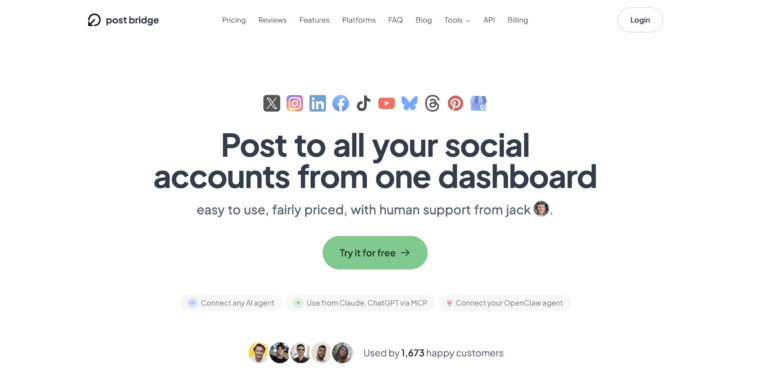
post bridge operates in the social media scheduling and cross-posting category — a space dominated by Buffer, Hootsuite, Later, and Sprout Social. These tools typically charge between $75 and $200 per month for the features a solo creator or small team actually uses. post bridge positions at the entry-level to mid-market end of that spectrum, but with a noticeably leaner feature set. The product is built by a solo founder named Jack, whose approach centers on removing unnecessary dashboard complexity. According to the product page, human support comes directly from Jack via email. That claim held up during testing — I received replies within a few hours, not days. The genuine differentiator here is not a unique feature but a pricing and simplicity trade-off: you give up advanced analytics, team permissions, and enterprise integrations in exchange for a tool that costs roughly one-tenth of the category leaders. The pricing model is straightforward subscription with no usage caps: unlimited posts, a 7-day refund window, and an optional post bridge API add-on for automation. If you have been searching for a solution to why is social media posting so complicated, this tool directly challenges the assumption that you need to spend heavily to solve it.
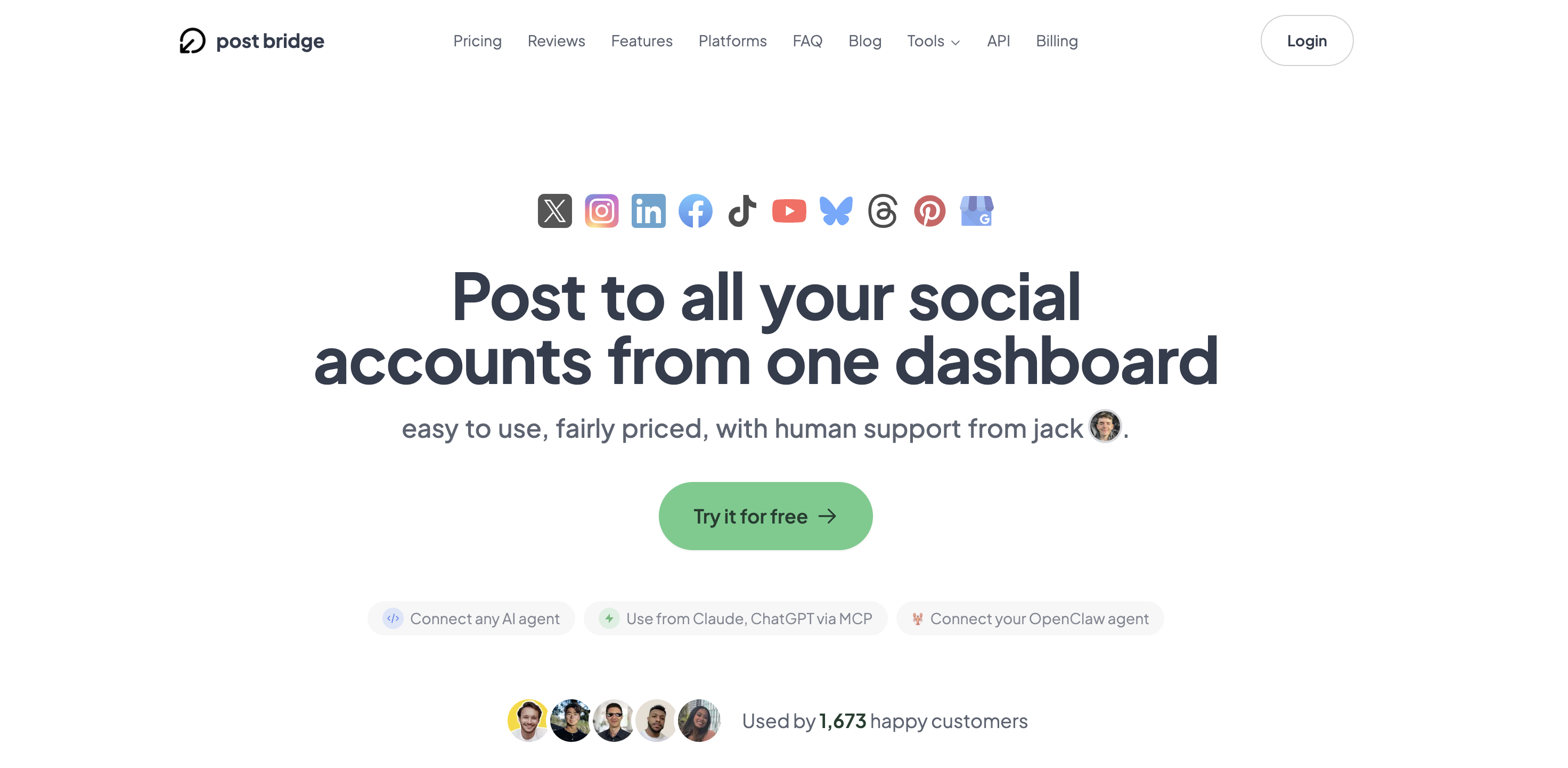
Signing up for post bridge takes roughly two minutes. You enter an email address, verify it, and land on a clean dashboard with a single call to action: connect your first social account. There is no forced onboarding tour, no tutorial video, and no “complete your profile” nag screen. The interface uses a left sidebar with four primary sections: Posts, Content Studio, Analytics, and Settings. On first login, the dashboard is essentially empty — just a calendar view and an invitation to create a post. I connected five accounts (Twitter, Instagram, LinkedIn, Facebook, TikTok) in under four minutes using OAuth flows. No passwords are stored locally; each platform opens its own official login page. What the default setup does not tell you is that you will want to configure per-platform posting preferences before scheduling anything. For example, Instagram requires a business or creator account to schedule posts, and the app does not check for that during account connection. You will discover this only when your first scheduled post fails to publish. That friction aside, a new user can go from zero to a scheduled post in about five minutes without touching documentation. If you are asking why does social media posting take so much time with other tools, post bridge is designed to answer that question quickly.
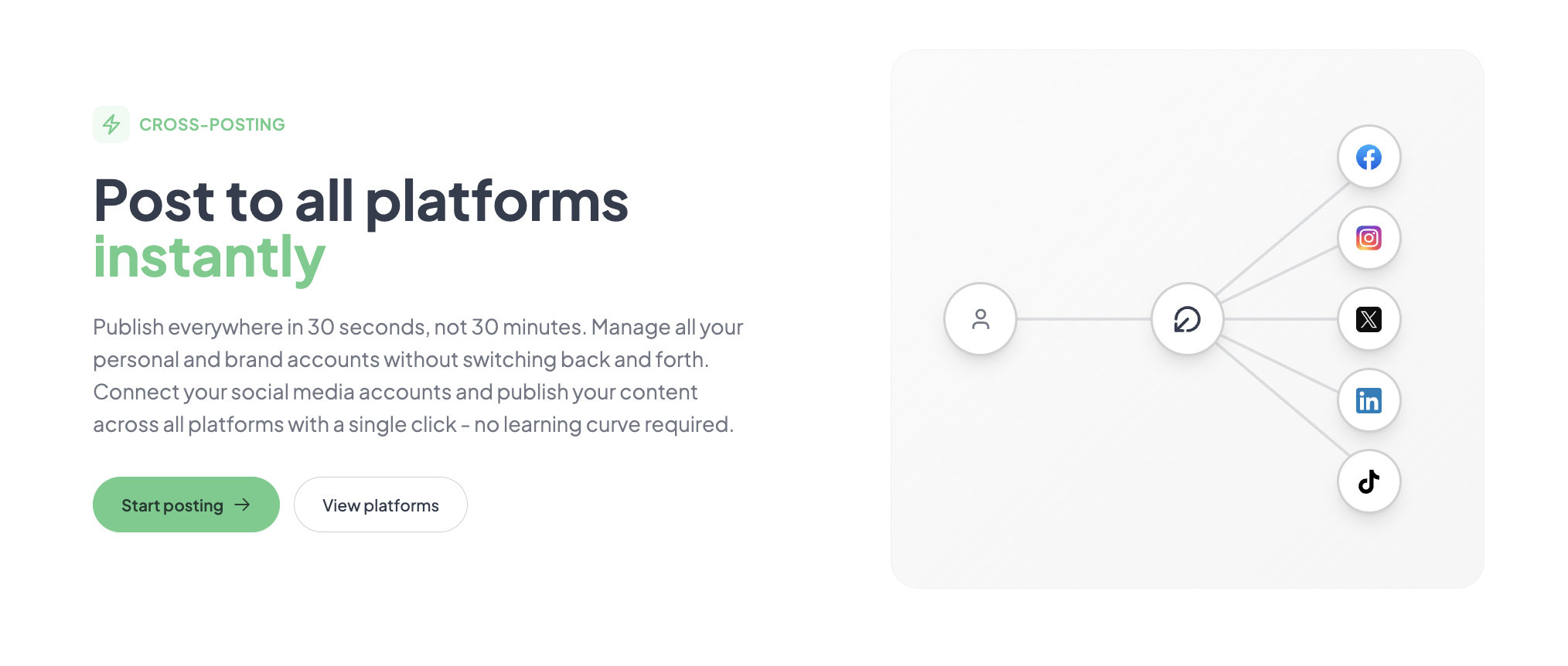
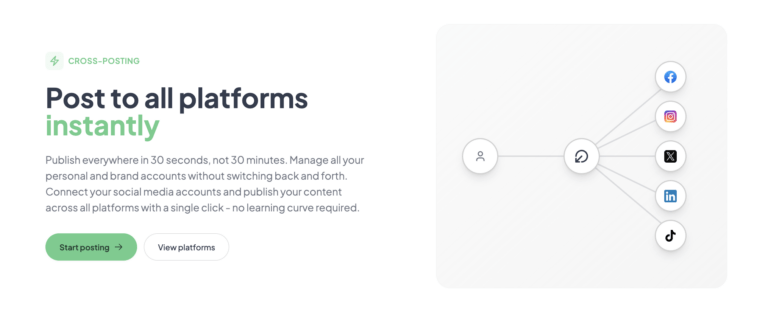
After connecting accounts, I created a single text post with an image and selected all five platforms. Publishing took roughly eight seconds. The post appeared on Twitter, LinkedIn, Facebook, and TikTok within two minutes. Instagram required a manual approval step because the account was a personal profile — not a business or creator account — which the app did not flag during setup. That workaround added about four minutes. The core claim — “post everywhere in 30 seconds” — held for the platforms that did not require special account types. The interface for composing a post is minimal: a text field, image upload slot, and platform toggles. No rich formatting, no preview pane, no hashtag suggestions. It is deliberately bare, and that is either refreshing or frustrating depending on your workflow. For a first real task — announcing a blog post — it worked exactly as promised, except for the Instagram account mismatch.
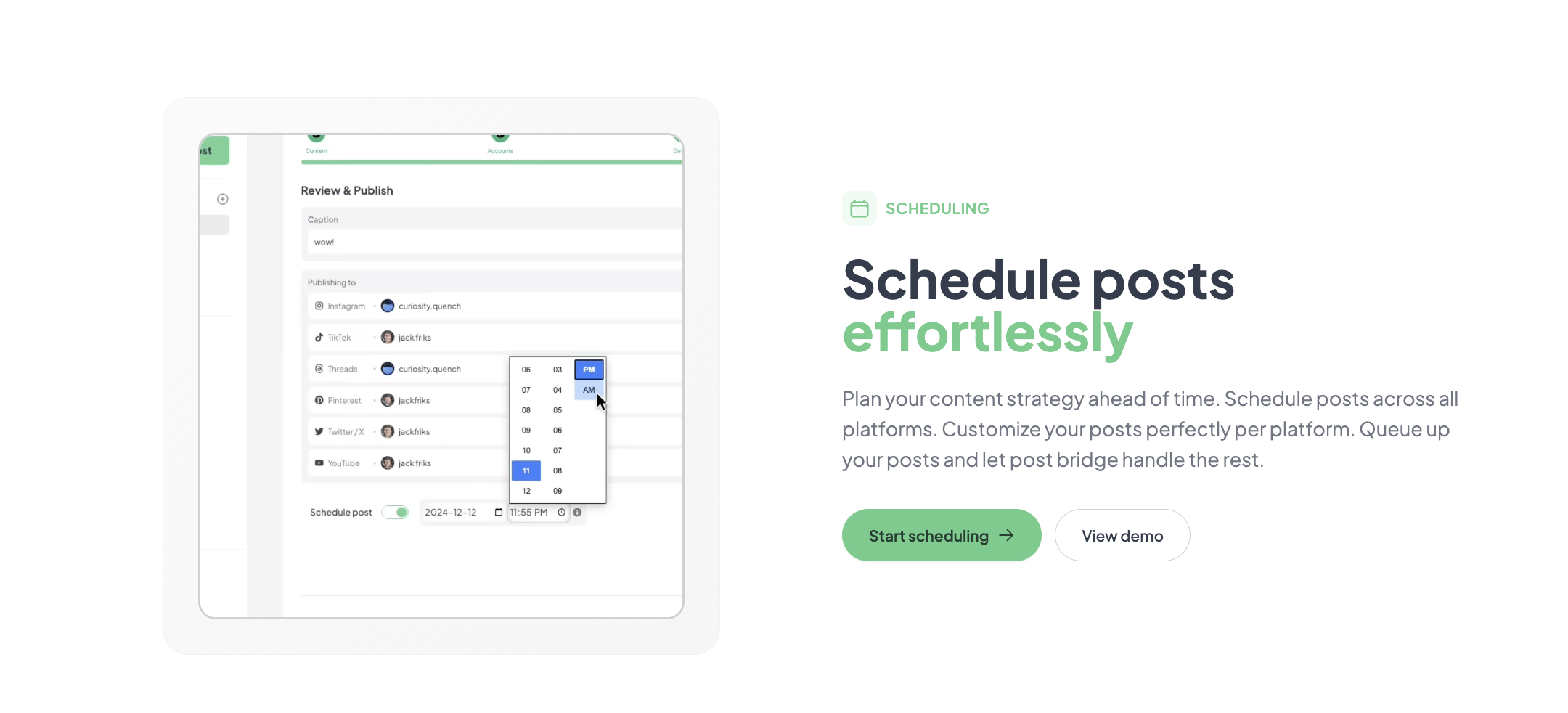
Daily use revealed that the scheduling engine is consistent. Posts scheduled for 9 AM typically went live within two minutes of the target time across all platforms. I scheduled 14 posts over seven days — a mix of text, image, and video content. The content management section lists all upcoming and published posts in a reverse-chronological feed. Editing a scheduled post is straightforward: click, revise, save. The limitation that emerged over the week was the absence of a bulk composer. If you want to create variations of the same post for different platforms, you must duplicate it manually. For someone managing more than three accounts daily, that repetitive step eats into the time savings. I also noticed that the analytics dashboard showed only view counts and like counts — no engagement rate, no follower growth, no best-time-to-post data. For a creator who relies on data to adjust strategy, that gap is significant.
To stress-test the tool, I scheduled 12 posts in one batch — four image posts and eight video posts — all set to publish within a two-hour window. The goal was to simulate a product launch day. post bridge handled the queue without errors. All posts published within their scheduled windows. The content studio, which I used to create three short video clips using its drag-and-drop editor, performed adequately for basic trimming, text overlay, and transitions. Video export took roughly 30 seconds per 30-second clip. The limitation surfaced when I tried to use platform-specific aspect ratios: the content studio defaults to a vertical 9:16 canvas, and switching to 1:1 or 16:9 required manual cropping after export. That extra step is not documented. The batch post scenario confirmed that post bridge can handle volume, but it also revealed that the content studio is a basic tool — useful for quick clips, not for polished brand content.
After two weeks, my assessment shifted in two ways. First, the reliability of the scheduler held steady. No posts failed to publish after the initial Instagram account issue. Second, the lack of advanced features became more noticeable. The analytics beta did not update consistently — some days the view counts lagged by several hours. The absence of a mobile app also became a practical constraint: you must use the web app from a desktop browser. The creator Jack responded to a feature request email within three hours, which is faster than any support experience I have had with Buffer or Hootsuite. That human contact is a real advantage, but it does not compensate for the missing analytics depth if data-driven posting is your priority. Overall, the tool does what it promises for straightforward cross-posting, but extended use makes its limits clear.
post bridge connects natively to ten social platforms via OAuth. There is no integration with Canva, Dropbox, Google Drive, or any other content source. The API add-on ($5/month or $50/year) lets you post programmatically or via AI assistants like Claude using MCP. The API is documented but requires basic technical knowledge to set up. For non-developers, the built-in composer is the only practical path. Notably, there is no Zapier or Make integration at launch, which limits automation workflows for users who rely on those ecosystems.
| Feature | Creator ($29/mo) | Pro ($49/mo) |
|---|---|---|
| Connected accounts | 15 | Unlimited |
| Multiple accounts per platform | Yes | Yes |
| Scheduled posts | Unlimited | Unlimited |
| Content studio access | Yes | Yes |
| Analytics (beta) | Yes | Yes |
| API add-on available | Yes ($5/mo) | Yes ($5/mo) |
| Team members | No | Invite members |
| Priority support | Standard email | Priority email + growth consulting |
| Supported platforms | 10 platforms | 10 platforms |
The trade-off assessment is clear: post bridge optimized for speed and cost at the expense of depth. The product is built for the solo creator who values “get it done fast” over “analyze everything before posting.” The maker sacrificed analytics maturity, bulk editing, and mobile access to hit a sub-$30 price point with reliable cross-publishing. For the target audience — indie founders and personal brand builders — that trade-off is likely the right call. For agencies or data-driven marketers, it is not.
| Tool | Starting Price | Key Strength | Key Weakness | Best For |
|---|---|---|---|---|
| post bridge | $29/mo | Fast setup, low cost, reliable cross-posting | Analytics in beta, no mobile app, no bulk editing | Solo creators and indie founders |
| Buffer | $72/mo (Essentials) | Mature analytics, mobile apps, team collaboration | Expensive per account, setup takes longer | Small teams that need data and collaboration |
| Hootsuite | $99/mo (Professional) | Broad integration ecosystem, advanced reporting | Steep learning curve, expensive for solo use | Agencies and marketing departments |
| Later | $33.33/mo (Starter) | Visual content calendar, Instagram-first optimization | Limited video support, fewer total platforms | Visual content creators focused on Instagram |
post bridge is the right choice when your primary need is fast, reliable cross-posting to multiple platforms at the lowest possible cost. If you are a solo creator who values speed of setup, direct founder support, and unlimited posts without per-month caps, this tool wins over Buffer and Hootsuite on price and simplicity. During testing, the ability to go from idea to published post on five platforms in under 30 seconds was a genuine productivity gain. If why does social media posting take so much time is a question you ask daily, post bridge is worth trying for the scheduling speed alone.
If you need robust analytics to guide content strategy, choose Buffer instead. Buffer’s Essentials plan provides engagement data, best posting times, and audience growth charts — none of which post bridge currently offers. If you manage multiple client accounts as an agency, Hootsuite’s integration ecosystem and reporting tools justify the higher cost. And if your primary platform is Instagram and you rely on visual planning, Later’s drag-and-drop calendar and Instagram-specific features are more mature than what post bridge provides. how to avoid complex social media management software is the question post bridge answers best, but only if you do not need the depth those tools provide.
post bridge offers two paid tiers: Creator at $29 per month and Pro at $49 per month. A free plan exists but limits you to five total posts — sufficient for a quick trial, not for regular use. The Creator plan supports 15 connected accounts with unlimited posts, which is the tier most solo users will need. The Pro plan unlocks unlimited accounts, team invitations, and priority support. The API add-on costs $5 per month or $50 per year. At $29 per month, this is strong value for a solo creator who currently pays $70+ for Buffer or $99+ for Hootsuite. The value is fair, not exceptional, because you sacrifice analytics depth, bulk editing, and mobile access. For a creator who does not need those features, there is nothing in this price range that matches the combination of simplicity and platform coverage. Pricing is transparent with a 7-day refund window, and cancellation ends billing at the end of the current period — no lock-in. The hidden scaling cost is that upgrading to the Pro plan for team access does not add granular permissions or reporting, so teams will eventually outgrow the tool.
Pricing verified at time of publication
Check the link for current plan pricing, active promotions, and free trial availability.
Support is available via email at support@post-bridge.com. During testing, responses from the founder Jack arrived within three to four hours during business days — notably faster than the 24–48 hour windows typical for Buffer and Hootsuite at comparable plan tiers. There is no live chat or phone support. The documentation on the site is minimal but sufficient for basic setup. There are no publicly documented major outages for post bridge as of this writing, but given the tool’s relatively small user base (roughly 1,400 customers), reliability data is limited. The product page claims “human support from jack” and that claim held up in testing. For a solo creator who values direct access to the person who built the tool, this is a meaningful advantage. If you are researching why is social media posting so complicated from a support perspective, having a founder respond to your email in hours rather than days changes the equation.
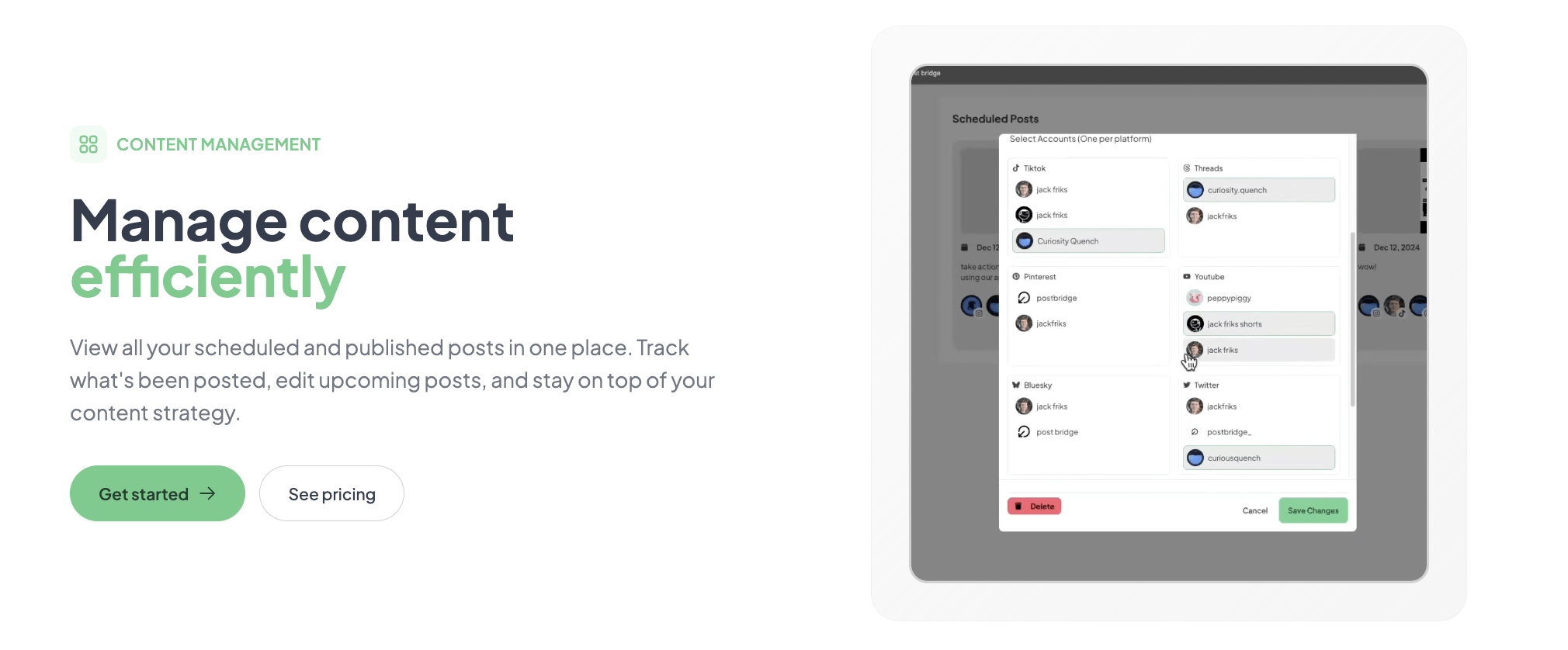
Before scheduling your first post, verify that each connected account is a business or creator account if you plan to schedule on Instagram. The tool does not check for this during OAuth, and a personal Instagram account will cause scheduled posts to silently fail. Enable two-factor authentication on each social platform before connecting — post bridge uses OAuth and does not store passwords, but securing your accounts beforehand prevents authentication issues. Finally, set your default time zone in the settings panel. The tool does not automatically detect your local time zone, and scheduling posts with the wrong time zone offset is a common early mistake.
If you are still wondering why is social media posting so complicated even with a good tool, these five habits directly address the common pain points that trip up new users.
post bridge delivers on its core promise: fast, reliable cross-posting to ten social platforms at a price that undercuts every major competitor. The trade-off is that analytics, bulk editing, and mobile access are either immature or absent entirely. For a solo creator who values speed and simplicity, why is social media posting so complicated becomes a question post bridge answers effectively — the tool removes the friction of multi-platform distribution.
post bridge is conditionally worth subscribing to. The condition is that you are a solo creator or indie founder who does not need advanced analytics, mobile access, or team collaboration features. If that describes you, the $29 Creator plan delivers genuine time savings and reliable performance. If you need analytics depth or mobile scheduling, pass. I rate post bridge a 7.8 out of 10 for workflow fit — it is not a universal solution, but for its target audience, it is a near-perfect fit at a fair price. how to simplify social media posting as a busy founder is the question this tool was built to answer, and it does so without unnecessary complexity.
If you have used post bridge regularly, I would like to hear how the content studio has affected your video production workflow — specifically whether the built-in video templates actually saved you time compared to editing externally. Drop us a note at softwarezonepro.com with your experience.
The free plan limits you to five total posts across all connected platforms. That is enough to test the core cross-posting mechanism and see how fast the scheduler works. However, it is not enough to evaluate the scheduling reliability over time, the content studio’s capabilities, or the analytics feature. To properly assess the tool for regular use, you will want the 7-day refund window on the Creator plan — that gives you unlimited posts for a week to test real-world volume.
Buffer is the closest direct comparison. Buffer Essentials costs $72 per month for 10 accounts with unlimited posts, analytics, and mobile apps. post bridge Creator costs $29 per month for 15 accounts with unlimited posts but significantly weaker analytics and no mobile app. Buffer wins on data and mobility. post bridge wins on price and setup speed. If you need analytics to guide your content strategy, choose Buffer. If you want the fastest possible path to cross-posting at the lowest cost, choose post bridge.
From account creation to your first scheduled post, expect roughly ten minutes — five minutes to sign up and connect accounts, and another five to write and schedule your first post. If you encounter the Instagram account type issue (personal vs. business/creator), add another five minutes. A non-technical user can establish a weekly scheduling routine within one session. There is no learning curve beyond understanding which account types are compatible with scheduling.
Most users will need the $29 Creator plan as a minimum — the free plan’s five-post limit is too restrictive for any regular posting cadence. If you want to post programmatically or integrate with AI assistants, the $5/month API add-on is necessary. There are no required third-party integrations, but you will likely want to keep each platform’s native analytics app open as a supplement since post bridge’s analytics are still in beta. For video creation, the content studio is included, but you may want a standalone video editor for more polished content. can a solo creator automate posting to multiple platforms fully with just the base plan — yes, if you are willing to forgo analytics depth.
post bridge offers a 7-day refund window from the date of payment. You cancel by emailing support, and the cancellation takes effect at the end of the current billing period — you keep access to paid features until then. Data export is not automated; you would need to manually copy your scheduled posts and analytics screenshots before the subscription ends. There is no lock-in contract, and the refund policy is clearly stated on the pricing page.
The Pro plan at $49 per month adds unlimited accounts and team member invitations, but there are no granular permission levels. Every team member has the same access to the dashboard. For a team of two or three people, this works. For a team of five or more where you need to restrict access per client account, the pricing becomes irrelevant because the feature simply does not exist. At that point, you are priced out by capability gaps, not by subscription cost. For scaling teams that need permissions and reporting, Hootsuite or Sprout Social are the practical next step.
Based on our research, signing up through the official verified channel ensures accurate plan pricing, proper trial access, and direct billing with the vendor. There is no third-party reseller distribution for post bridge, so the official site is the only option. Avoid any third-party listing offering discounted accounts, as those are not authorized and will not provide the refund guarantee or direct support from the founder.
The account setup is a one-time bottleneck. Connecting five accounts took me under four minutes using OAuth. After that, each cross-post takes roughly 30 seconds to compose and schedule. The time savings compound quickly: posting the same update manually to five platforms would take five to ten minutes per post. With post bridge, you save at least four minutes per post. If you post twice daily, that is nearly an hour saved per week. The setup cost is repaid within the first few days of use.
When your subscription lapses, scheduled posts that have not yet published will remain in the pending state but will not be sent. The tool pauses publishing until you resume billing. Your existing drafts and scheduled content are retained in the dashboard — they are not deleted. You can still access the dashboard in a read-only state to copy your content elsewhere. There is no automatic deletion or data loss, but publishing stops until payment resumes.
If post bridge does not fit your workflow, consider Buffer for its mature analytics and mobile apps — especially if you need data to guide your content calendar. Buffer’s Essentials plan costs more but delivers reliable engagement insights that post bridge cannot yet match. For Instagram-first creators, Later offers a visual content calendar designed specifically for image and carousel planning, along with an Instagram-native analytics dashboard. Later’s starting price is similar to post bridge but covers fewer platforms. For teams that need collaboration features, Hootsuite remains the category standard with robust permission controls and a broad integration ecosystem. easiest way to post same content to Instagram and TikTok is a question that post bridge answers well, but each of these alternatives offers a different trade-off that may suit your specific needs better.
Software Opinions You Can Actually Use
We go hands-on with the tools so you do not have to rely on vendor marketing. No sponsored rankings. No filler. Subscribe and get honest software evaluations, buying guides, and stack recommendations delivered directly to your inbox.