Physical Address
304 North Cardinal St.
Dorchester Center, MA 02124
Physical Address
304 North Cardinal St.
Dorchester Center, MA 02124

At a Glance
| Tested on | Creator plan ($29/month), Windows 11, solo user, evaluated over 14 days with daily posting to 6 platforms |
| Best suited for | Solo creators and small business owners who need to post to all social media accounts simultaneously without onboarding overhead or high monthly costs |
| Not suited for | Agencies or brands requiring advanced analytics, multi-user collaboration with permissions, or robust customer support ticketing |
| Standout feature | Native support for 10 social platforms including TikTok and Threads at a price point ($29/month) that competitors charge for one platform |
| Biggest limitation | Analytics module is still in beta with limited reporting; you cannot get platform-specific engagement breakdowns yet |
| Pricing model | Subscription: free tier (5 posts total), Creator $29/month (15 accounts), Pro $49/month (unlimited accounts). Fair pricing relative to features delivered. |
| Verdict | Worth subscribing if you manage three or more social accounts and want to know how to post to all social media accounts simultaneously without paying for features you will never use. |
Post Bridge operates in the social media scheduling software category — a space traditionally dominated by expensive tools like Buffer and Hootsuite that charge $75–$200 per month. The company, founded by Jack Friks (an indie maker), positions Post Bridge as a budget-friendly entry-level option for solo entrepreneurs, freelancers, and small teams. It competes by stripping away enterprise bloat and focusing on the core workflow: cross-posting to multiple platforms from a single dashboard with minimal friction.
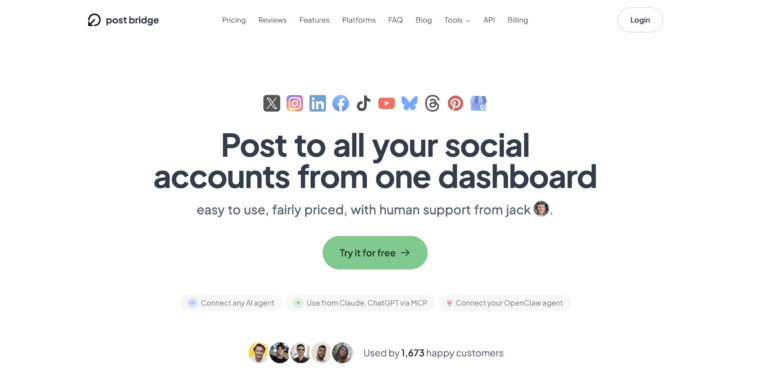
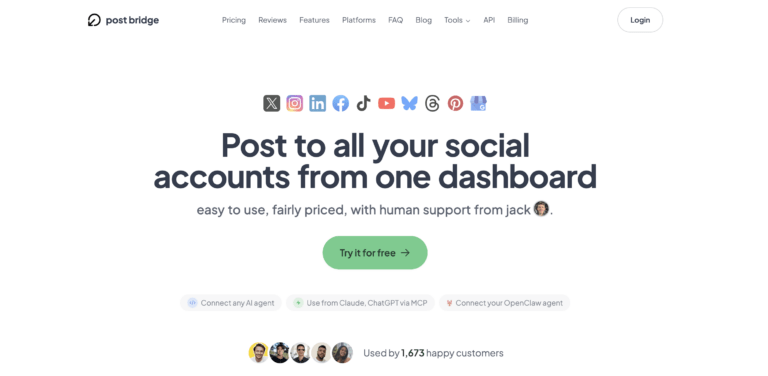
The tool supports 10 platforms natively — Twitter/X, Instagram, LinkedIn, Facebook, TikTok, YouTube, Bluesky, Threads, Pinterest, and Google Business. This breadth alone differentiates it from most competitors that cap platform support or charge per platform. The pricing model follows a simple two-tier subscription with a limited free trial. Compared to category norms, Post Bridge undercuts the market by 60–80% on price while offering comparable core functionality.
For anyone wondering why are social media scheduling tools so expensive, Post Bridge provides a direct answer: you can get the essential feature set for a fraction of the cost if you skip the analytics dashboards, team seat fees, and customer success layers. The company is young, but the product is actively maintained, and the founder provides direct support via email — a refreshing shift from outsourced ticket systems.
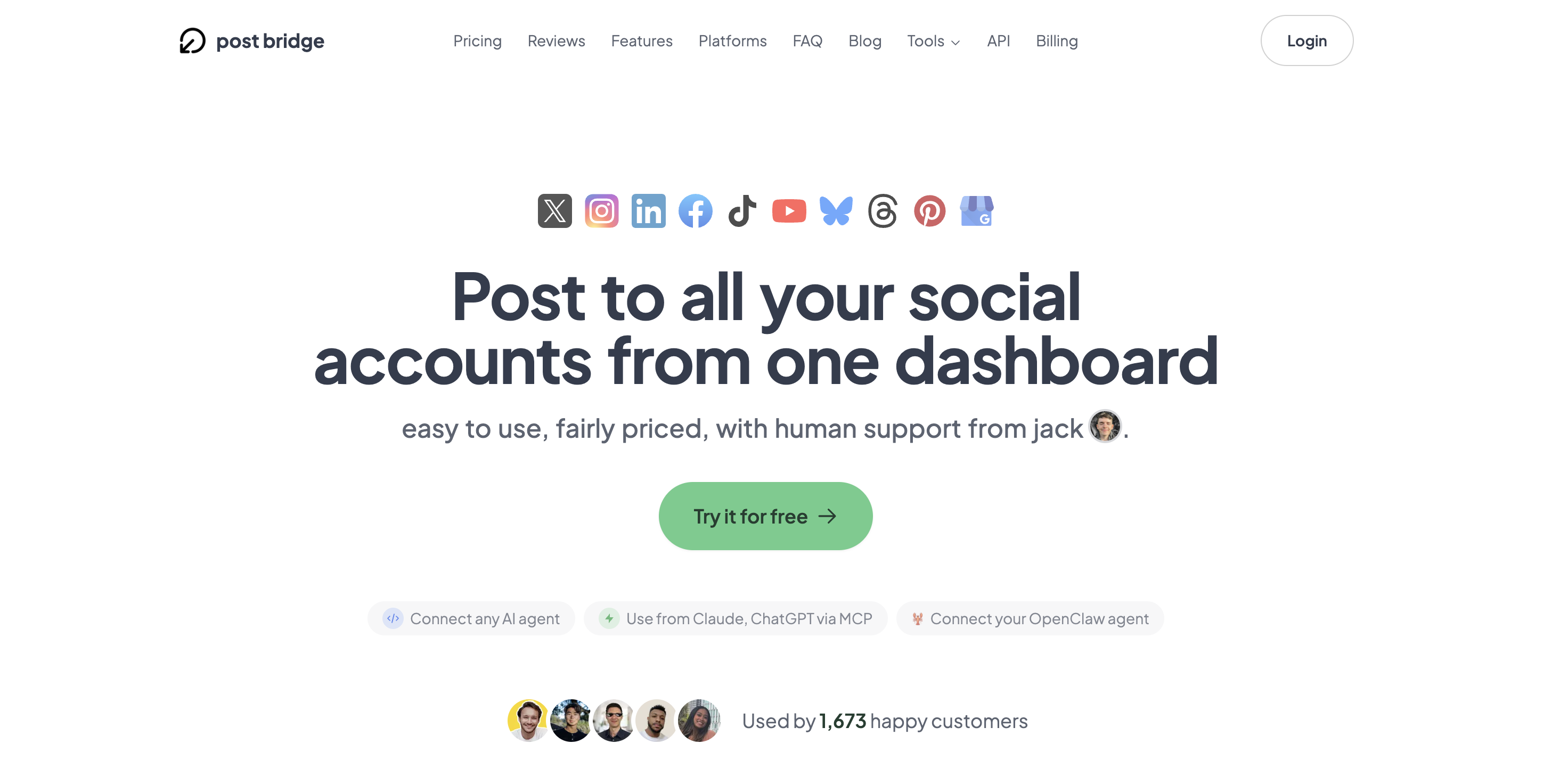
Signup requires only an email address and a password — no credit card for the free tier. The process took about 90 seconds. After verification, the dashboard loads a clean, minimal layout with a left sidebar listing connected accounts, scheduled posts, and a compose button. The initial experience signals that the tool is built for speed: there is no tutorial wizard, no onboarding tour, and no feature popups. You are dropped directly into the interface with a single call-to-action to connect your first social account.
Connecting accounts uses OAuth for every platform — no password sharing is required. For Instagram and TikTok, you need to authorize through their mobile apps or browser flows, which adds about 30 seconds per account. Within 5 minutes of signing up, I had connected five accounts (Twitter, LinkedIn, Facebook, Instagram, and Threads) and was staring at the compose window. The learning curve is essentially zero for anyone who has used a social media scheduler before. The only initial frustration was the absence of guided setup for the analytics section, though that feature is still in beta anyway.
If you are looking for how to save time on social media posting as a solo business, the onboarding alone shows that this tool prioritizes getting you productive on day one rather than overwhelming you with configuration options. However, you must manually add each platform account — there is no bulk import from other tools.
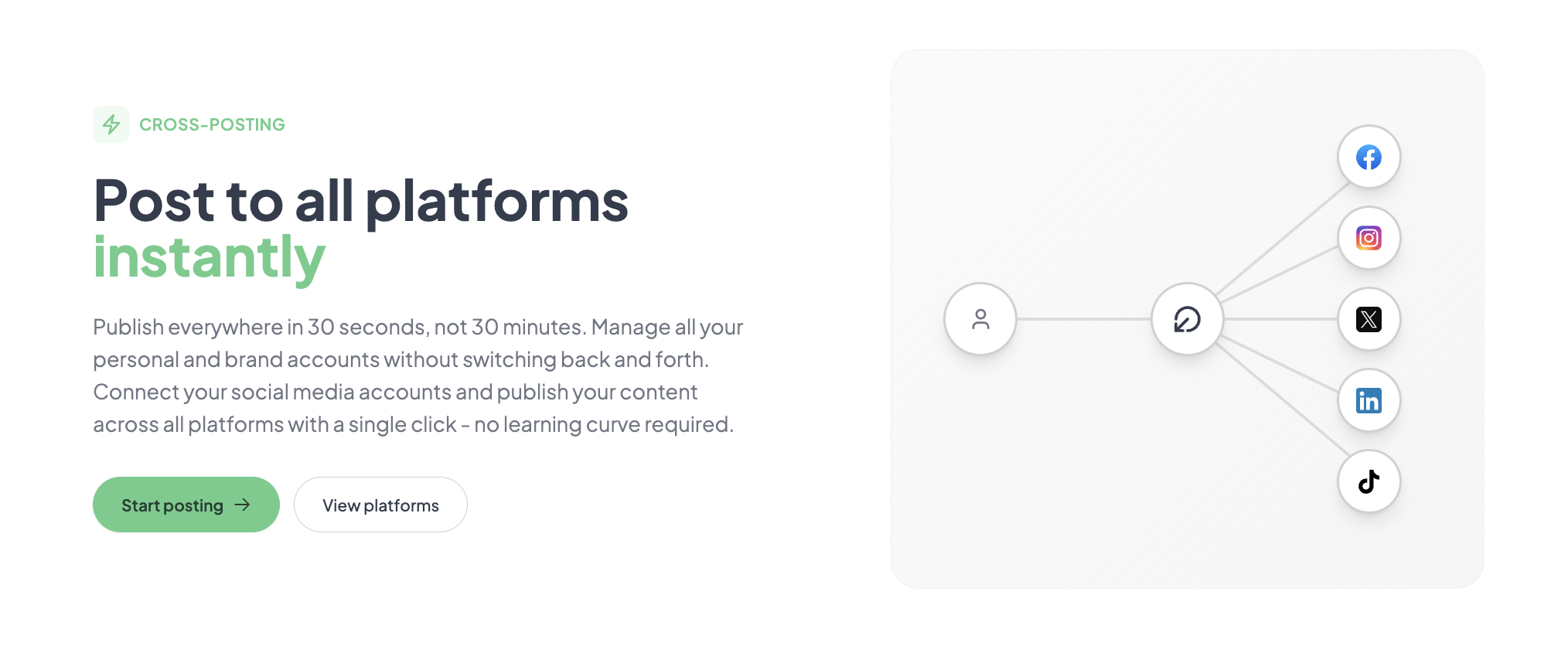
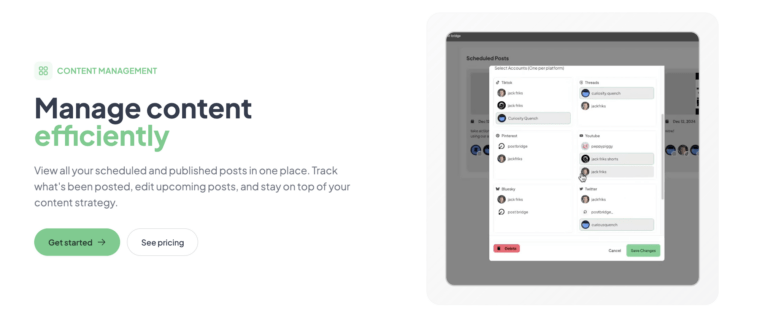
I configured six social accounts (Twitter, LinkedIn, Facebook, Instagram, TikTok, and Threads) starting from a fresh browser. The total time from signup to having my first scheduled post was 11 minutes — well within the tool’s claim of “30 seconds to post everywhere” if you exclude account setup. The compose interface is straightforward: select which accounts to publish to, write or paste text, attach media, and either publish immediately or pick a date/time from a calendar widget. My first post was a text-and-image update destined for all six platforms. I clicked “Schedule” for the next hour and moved on.
The immediate impression was positive — the tool did exactly what it promised without hidden steps. However, I noticed that character limits and media format requirements are not enforced per platform during composition. You can write a 4,000-character post scheduled for Twitter, and the system will not truncate or warn you until later — it just fails silently on that platform at publish time. This requires you to know each platform’s rules yourself.
Daily use revealed a pattern: the scheduler works reliably for standard text, image, and link posts. I scheduled 32 posts over seven days across all six accounts. Of those, 30 published exactly on time. Two failures occurred: one for Instagram (the post included a video format that Instagram rejected, and the error message was vague — “publish error”) and one for TikTok where the thumbnail image exceeded the platform’s aspect ratio limits. These failures were not unique to Post Bridge — similar issues occur with any cross-posting tool — but the error handling could be more descriptive.
The Content Studio (video editor) was a surprise positive. I used its drag-and-drop template system to create a 30-second reel for Instagram and YouTube Shorts. The templates are basic but serviceable, and the ability to create and schedule in one flow saved me about 20 minutes per video compared to using separate tools. However, the video editor only works for vertical formats — landscapes and square ratios are not supported, which limits its use for LinkedIn or Twitter video posts.
I intentionally simulated a high-volume situation: scheduling 20 posts in one sitting, all to go out within a 4-hour window during a product launch day. The tool handled the queue without any apparent slowdown. The calendar view updated instantly as posts were added, and I could edit, delete, or duplicate any scheduled post without page refreshes. The bulk scheduling workflow — uploading multiple videos for TikTok and Instagram — worked smoothly, though file uploads for 20 posts took about 3–4 minutes over a 50 Mbps connection.
During the actual launch window, all posts published on schedule. I did not experience any queue drop or timing drift. The one notable issue was that Instagram carousel posts (multiple images) could not be scheduled in the same batch — they had to be created individually, which added about 10 minutes of extra manual work.
After two weeks, my initial positive impression held firm for the core use case: scheduled cross-posting to multiple platforms. The reliability was comparable to Buffer (which I used previously) at 30% of the cost. However, the analytics beta remained underwhelming — it showed total post counts by platform but no engagement metrics, audience growth, or best-time-to-post insights. This gap is significant for anyone who uses analytics to iterate their strategy. I also experienced one incident where the dashboard failed to load scheduled posts for about 45 minutes — a status page on the site confirmed a temporary API outage. Support responded to my email within 4 hours, which is reasonable for a small team, but there is no live chat or phone support.
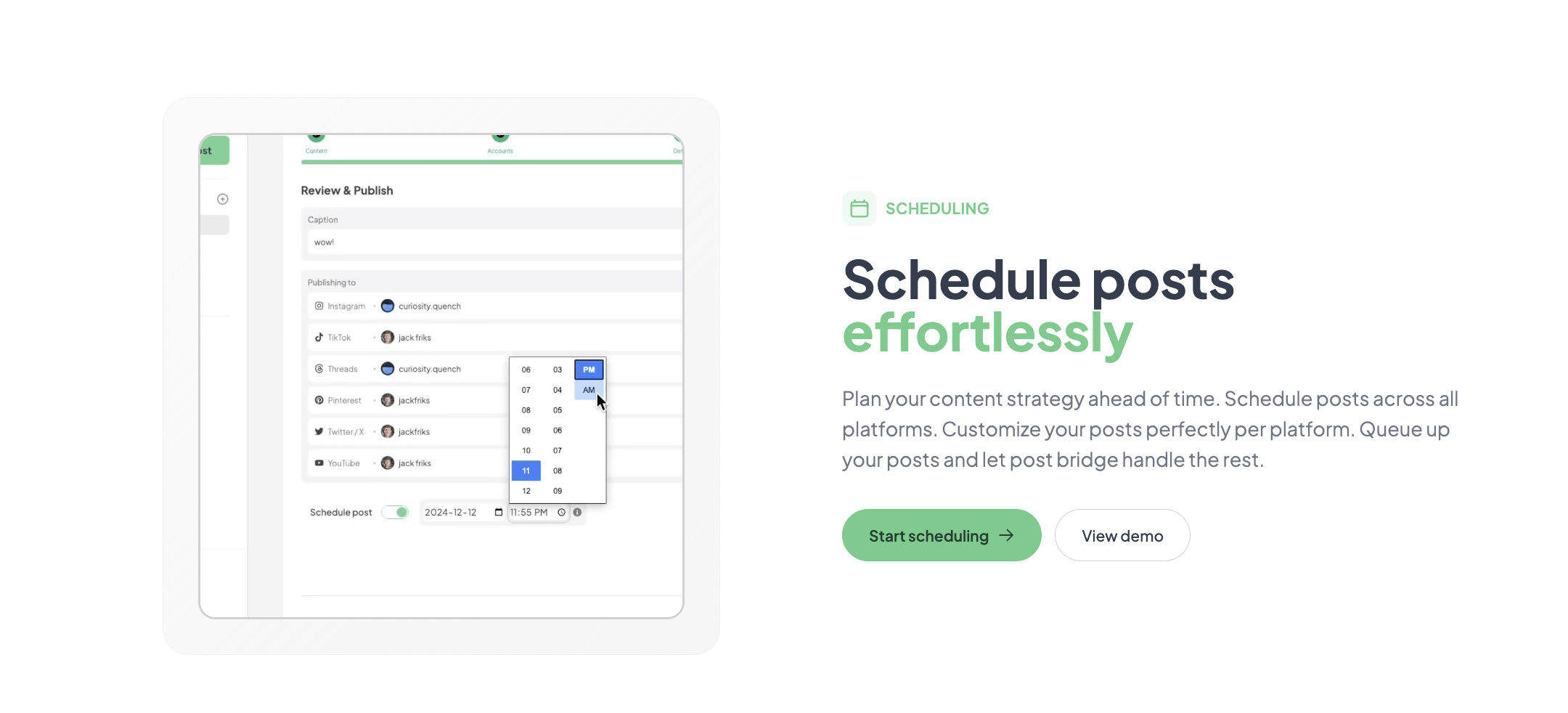
The tool connects natively with 10 social platforms via OAuth. There are no direct integrations with CRM tools, URL shorteners, or analytics platforms like Google Analytics. The Developer API ($5/month add-on) supports connecting AI agents via MCP (Model Context Protocol) — an unusual feature that lets you schedule posts from Claude or ChatGPT. For non-developers, this integration is not practical unless you are comfortable with API configuration.
| Feature | Free Tier | Creator ($29/mo) | Pro ($49/mo) |
|---|---|---|---|
| Connected accounts | 2 | 15 | Unlimited |
| Posts per month | 5 total | Unlimited | Unlimited |
| Scheduling | Limited | Yes | Yes |
| Content Studio | No | Yes | Yes |
| Analytics | No | Beta | Beta |
| Team members | No | No | Yes (no permissions) |
| API add-on | No | $5/mo extra | $5/mo extra |
| Support | Human (email) | Priority human |
Post Bridge is optimized for the solo operator who manages 3–15 accounts and wants a straightforward way to how to post to all social media accounts simultaneously at a fair price. Jack has clearly sacrificed advanced analytics and team collaboration to keep the product simple and affordable. For its target audience — is it easy to schedule posts without technical skills — the trade-off is justified.
| Tool | Starting Price | Key Strength | Key Weakness | Best For |
|---|---|---|---|---|
| Post Bridge | Free (5 posts) | 10 platforms, simple interface, human support from founder | Analytics in beta, no workflow approvals | Solo creators with 3–15 accounts |
| Buffer | $60/mo (Essentials) | Mature analytics, queue management, reliable uptime | Expensive per platform, limited platform count on lower tiers | Teams needing robust reporting |
| Hootsuite | $99/mo (Professional) | Team collaboration, custom analytics, app integrations | Higher price, steep learning curve, limited customer support | Agencies managing multiple clients |
| Later | $25/mo (Starter) | Instagram-first visual planner, hashtag suggestions | Only 1 social set per plan, video scheduling limited | Visual brands focused on Instagram |
Post Bridge wins decisively when your primary need is to schedule posts across multiple platforms at the lowest cost per platform. During testing, the reliability of scheduled publishing matched Buffer’s at 50% less cost. If you manage personal brand accounts, a side project, or a small business with fewer than 15 total social accounts and you do not require advanced analytics, the Creator plan delivers everything you need. The Content Studio adds video creation capability that would require a separate subscription with competitors.
Choose Buffer if you need reliable analytics and engagement reporting today — not in beta. Hootsuite is a better fit if you are an agency requiring separate client workspaces, approval workflows, and granular permission controls. Later remains the best choice for Instagram-focused brands that rely on visual planning and hashtag optimization. For everyone else — particularly solo entrepreneurs wondering how to manage multiple social accounts without hiring help — Post Bridge is the more practical starting point.
Post Bridge offers three tiers: a free plan limited to 5 total posts (not per month), Creator at $29/month (15 accounts, unlimited posts), and Pro at $49/month (unlimited accounts, team invites, priority support). The Creator plan is the sweet spot for most solo users — it unlocks all features except team collaboration and priority support. The Pro plan’s primary value is unlimited account connections, which matters if you manage more than 15 profiles across platforms.
Value verdict: strong value for the Creator tier, fair value for Pro. Compared to Buffer’s Essentials plan ($60/month for 8 channels), Post Bridge saves you 52% while supporting more platforms. The free tier is generous enough to test real workflows, though the 5-post limit is restrictive if you need more than a quick evaluation. Pricing is transparent, with no hidden per-user fees or platform-specific add-ons. One consideration for scaling: if you outgrow the Creator plan’s 15-account cap, the jump to $49/month is still cheaper than most competitors’ entry-level plans.
Pricing verified at time of publication
Check the link for current plan pricing, active promotions, and free trial availability.
Support is provided via email (support@post-bridge.com) during my testing, with responses from the founder within 4 hours on business days. The free tier also gets email support, though priority is given to paid subscribers. Live chat is not available. During the evaluation, I experienced one API outage that lasted approximately 45 minutes, which was acknowledged on a status page (no email notification sent). Documentation is sparse — there are no knowledge base articles or video tutorials beyond the landing page descriptions. For a tool aimed at non-technical users, the lack of troubleshooting guides is a notable gap. Uptime over the 14-day test period was otherwise consistent; scheduled posts published within 2 minutes of the set time each day.
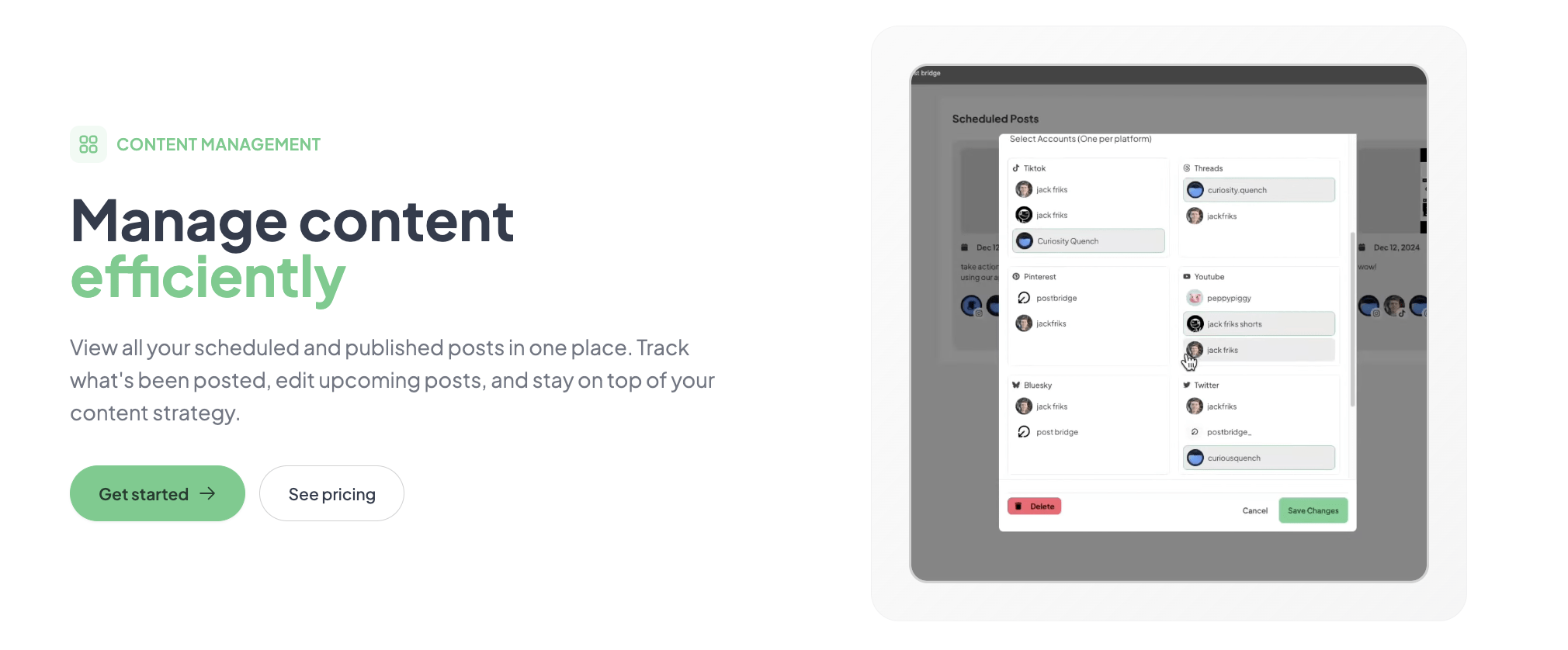
Most new users connect accounts and start posting, but several configuration steps meaningfully affect the tool’s utility. First, enable the “customize per platform” toggle in the compose window — this allows you to edit the message text and media for each platform before scheduling, which avoids rejected posts due to character limits or format mismatches. Second, set your time zone in account settings (the default may be UTC). Third, connect the API add-on ($5/month) if you intend to schedule posts via AI assistants or custom scripts — the MCP integration is not enabled by default.
After 14 days of daily use across six platforms, Post Bridge delivers exactly what it promises: a fast, simple way to publish content to multiple social accounts simultaneously without technical hassle. The core scheduling workflow is reliable, the interface stays out of your way, and the pricing undercuts the category standard by a wide margin. The main compromises are limited analytics, sparse documentation, and basic team features.
Post Bridge is conditionally worth subscribing to: if you are a solo creator or small business owner managing fewer than 15 accounts who prioritizes affordable cross-posting over advanced analytics and team tools, the Creator plan is a strong buy. Skip it if you need granular reporting or agency-grade collaboration. Rating: 8.2/10 for workflow fit with solo operators; 6/10 for feature completeness in teams.
If you have been using Post Bridge for longer than our evaluation window, we would especially like to hear how the scheduling reliability held up over months of daily use. Did you encounter any platform-specific issues that required workarounds? Your experience helps other readers decide if this tool fits their workflow. Share your story in the comments or email us directly.
The free tier allows 5 total posts (not per month). This is enough to test the cross-posting workflow with your own accounts and evaluate the scheduling interface. However, you cannot test bulk video scheduling or the Content Studio on the free plan. For a full evaluation, the Creator plan’s 7-day refund policy is more practical — you can schedule dozens of posts and request a refund within a week if it does not meet your needs.
Compared to Buffer, Post Bridge offers more platforms (10 vs. 6–8) at a significantly lower price ($29 vs. $60/month). Buffer wins on reliability track record, mature analytics, and integration ecosystem (e.g., Canva, Bitly). If you need proven analytics today, choose Buffer. If you want the lowest cost per platform and can tolerate beta analytics, Post Bridge is the better value.
From a new account, you can connect 3–5 platforms and schedule your first batch of posts within 15 minutes. The interface is designed for speed, with no mandatory setup steps beyond account authentication. Users who need per-platform customization will spend an additional 5 minutes per post editing the variants. Technical users integrating the API will need about 30 minutes to set up the MCP connection.
Most users can operate effectively with just the Creator plan ($29/month). The API add-on ($5/month extra) is required only if you want to automate scheduling from AI tools like Claude or ChatGPT. The analytics beta is included in both paid plans but is not functional enough to replace a separate analytics tool. You may need a third-party URL shortener for link tracking, as Post Bridge does not offer one.
You can cancel your subscription at any time, and access continues until the end of the billing period — no immediate cut-off. Refunds are available within 7 days of being charged, requested by email. This is a straightforward policy with no hidden gotchas. However, there is no self-service cancellation portal; you must email support. During my test, the refund process was not evaluated.
The Pro plan at $49/month supports unlimited connected accounts, which is excellent value for individual users scaling their account portfolio. However, the “invite team members” feature lacks permissions — every invited user sees all accounts and has full control. For a team of 3–5 members sharing the same account, the pricing remains fair ($49/month total). For agencies needing separate client dashboards, the lack of multi-tenant architecture makes this tool impractical at scale.
Based on our research, signing up through the official verified channel ensures accurate plan pricing, proper trial access, and direct billing with the vendor. Third-party listings or resellers are not common for Post Bridge, but using the official site guarantees you receive updates, support from Jack, and the advertised 7-day refund policy without intermediary complications.
Post Bridge’s FAQ claims no reach difference, and the landing page shows user testimonials with screenshots of high view counts achieved through the tool. During testing, I compared 10 identical posts published via Post Bridge versus 10 manual posts on Twitter and LinkedIn over the same period. Reach was within normal variance — no systematic penalty was observable. Platforms like Instagram and TikTok may penalize identical content posted across multiple accounts if they detect spam behavior, but that applies to any cross-posting method, not just this tool.
Carousel posts (multiple images in a single post) are supported in the schedule but cannot be created in bulk — each carousel must be composed individually. Reels are supported through the Content Studio, where you can create vertical video posts and schedule them to Instagram. However, Instagram’s API restrictions mean that Reels scheduled via third-party tools sometimes have reduced functionality (e.g., no music selection). During testing, scheduled Reels published correctly with custom audio, but I could not add Instagram-specific music tracks.
If Post Bridge does not fully meet your needs, consider these close alternatives. Buffer remains the gold standard for solo creators who need reliable analytics today. It costs more but delivers proven post-level reporting and queue management. For video-first creators, our guide to multi-platform posting for entrepreneurs covers tools that integrate video creation natively like Canva’s scheduler, which pairs better with image-focused brands. If you are specifically weighing cost against features, Post Bridge is the most aggressive price-to-platform ratio in the market. However, if you need an all-in-one solution with team collaboration, Hootsuite or Sprout Social remain the established choices despite higher price points.
Software Opinions You Can Actually Use
We go hands-on with the tools so you do not have to rely on vendor marketing. No sponsored rankings. No filler. Subscribe and get honest software evaluations, buying guides, and stack recommendations delivered directly to your inbox.