Physical Address
304 North Cardinal St.
Dorchester Center, MA 02124
Physical Address
304 North Cardinal St.
Dorchester Center, MA 02124

Managing social media across multiple platforms as a solo founder or freelancer quickly becomes a time sink that eats into product development and client work. I was spending nearly an hour each day manually posting updates to Twitter, LinkedIn, Instagram, and Facebook — often forgetting to cross-post or reformatting content repeatedly. After trying a few social media scheduler for solopreneurs tools that either felt overpriced or overly complex, I stumbled upon post bridge. I evaluated the platform for a full week, testing its free tier and then upgrading to the Creator plan on macOS with five connected accounts — my own startup accounts. This article covers the real performance, the limits, and whether this best social media scheduler small business actually delivers on its promise to save time without wrecking reach. By the end, you will know if this is the right multi-platform posting tool for your workflow.
At a Glance
| Tested on | Free tier then Creator plan, macOS Sonoma, Chrome, 5 connected accounts, 7 days of regular use |
| Best suited for | Solopreneurs and micro-teams who need a cheap, simple way to cross-post to 5–15 accounts without learning a complex dashboard |
| Not suited for | Agencies managing dozens of client accounts or teams that require advanced analytics, role-based permissions, or deep reporting |
| Standout feature | Content Studio for quick drag-and-drop video creation with proven templates — actually saved me hours repurposing content |
| Biggest limitation | Analytics are still in beta and lack the depth most marketers expect — you get basic view counts but no engagement breakdowns |
| Pricing model | Free tier with 5 total posts, then $29/month Creator (15 accounts) or $49/month Pro (unlimited). Fair for what you get, especially compared to rivals |
| Verdict | Conditionally worth it: if you are a solopreneur who values simplicity and low cost over feature depth, this is the best cross-posting tool for small teams at this price point. |
The social media management category is dominated by tools like Buffer, Hootsuite, and Later — all charging $50–$200 per month for plans that include features most solopreneurs never touch. post bridge positions itself as an entry-level alternative that strips out enterprise bloat. The company, run solo by founder Jack, launched recently and already serves over 1,400 customers. Its primary differentiators are a flat, low monthly price, unlimited posts on paid plans, and direct human support from Jack himself rather than a ticket system. The pricing model — freemium with two simple paid tiers — is refreshingly transparent compared to the per-seat creep of competitors. For a social media scheduler for solopreneurs that needs affordable social media management for startups, this is a compelling entry point.
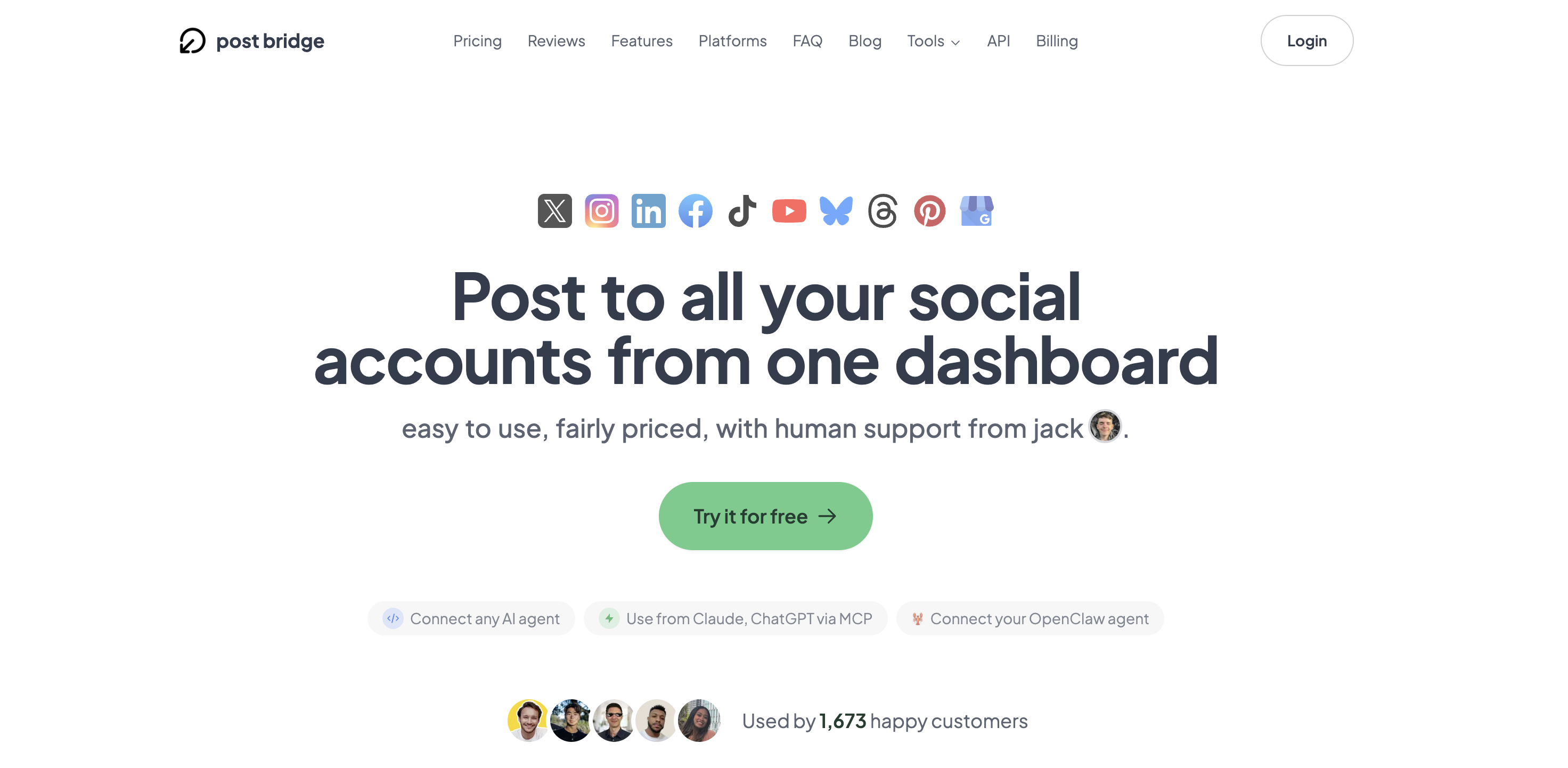
Signing up takes an email and a password — under two minutes. The next step is connecting social accounts via OAuth, which is straightforward for each of the ten supported platforms. The dashboard appears immediately after: a clean, minimal interface with a single “New Post” button and a calendar view for scheduled content. I was able to write a post, attach an image, select four platforms, and publish in about 40 seconds. The default experience does not require any documentation — the workflow is intuitive enough that a new user can go from signup to a live post in under five minutes. However, on the free tier you are limited to five total posts across all platforms, which is very restrictive for evaluation. You will hit that limit in a single session if you cross-post to five accounts. Upgrading is necessary to assess the tool realistically. This is a common social media scheduling pros and cons for solopreneurs trade-off: free tier is a teaser, not a trial.
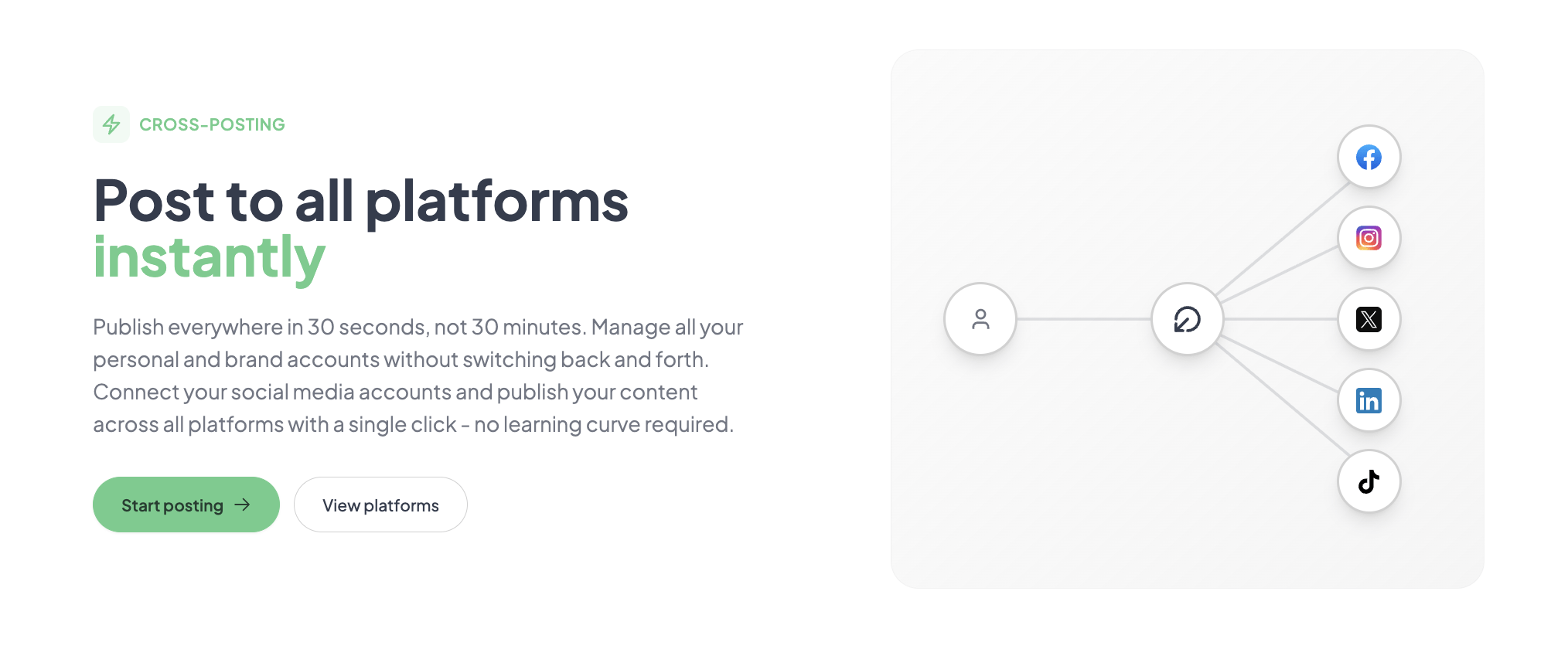
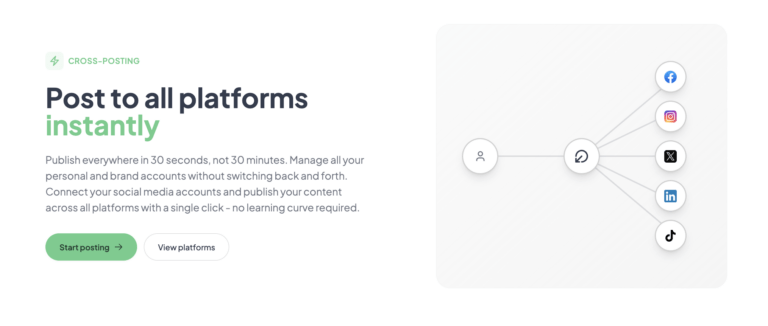
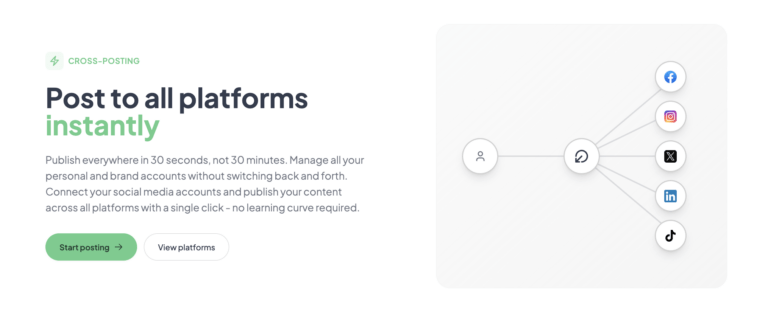
After upgrading to the Creator plan, I connected five accounts — Twitter, LinkedIn, Facebook, Instagram, and a separate Instagram business page. The initial configuration, including account connections and testing a single post, took about 10 minutes. The core workflow matched the claim: write text, attach media (image or video), choose platforms, and hit publish or schedule. The first real task — a product announcement — went to all five platforms simultaneously in under 30 seconds. No formatting issues on any platform except Instagram, which required a square crop that the tool handled automatically. This immediate success is where the social media scheduler for solopreneurs shines most: it removes the friction of manual cross-posting without adding a learning curve.
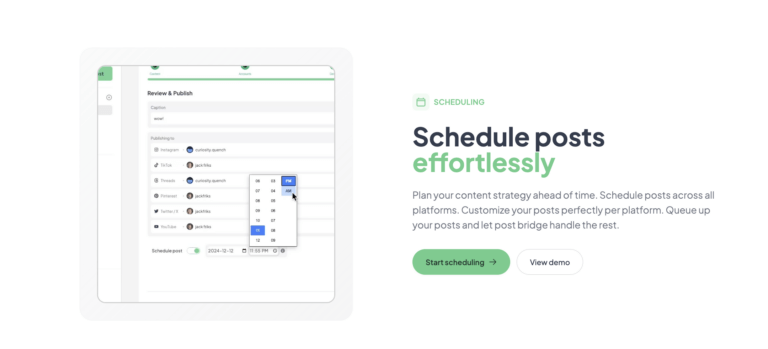
Over seven days I posted daily — roughly three posts per day, each going to three to five platforms. The tool’s reliability held steady: no failed posts, no duplicate content, and no unexpected account disconnects. The scheduling feature (select a future date/time) worked exactly as expected. The main friction that emerged was the lack of a unified content library. Each post’s media lives only in that post; there is no reusable asset repository. For someone posting similar content repeatedly, this means re-uploading the same image or video each time. It is minor but noticeable over a week.
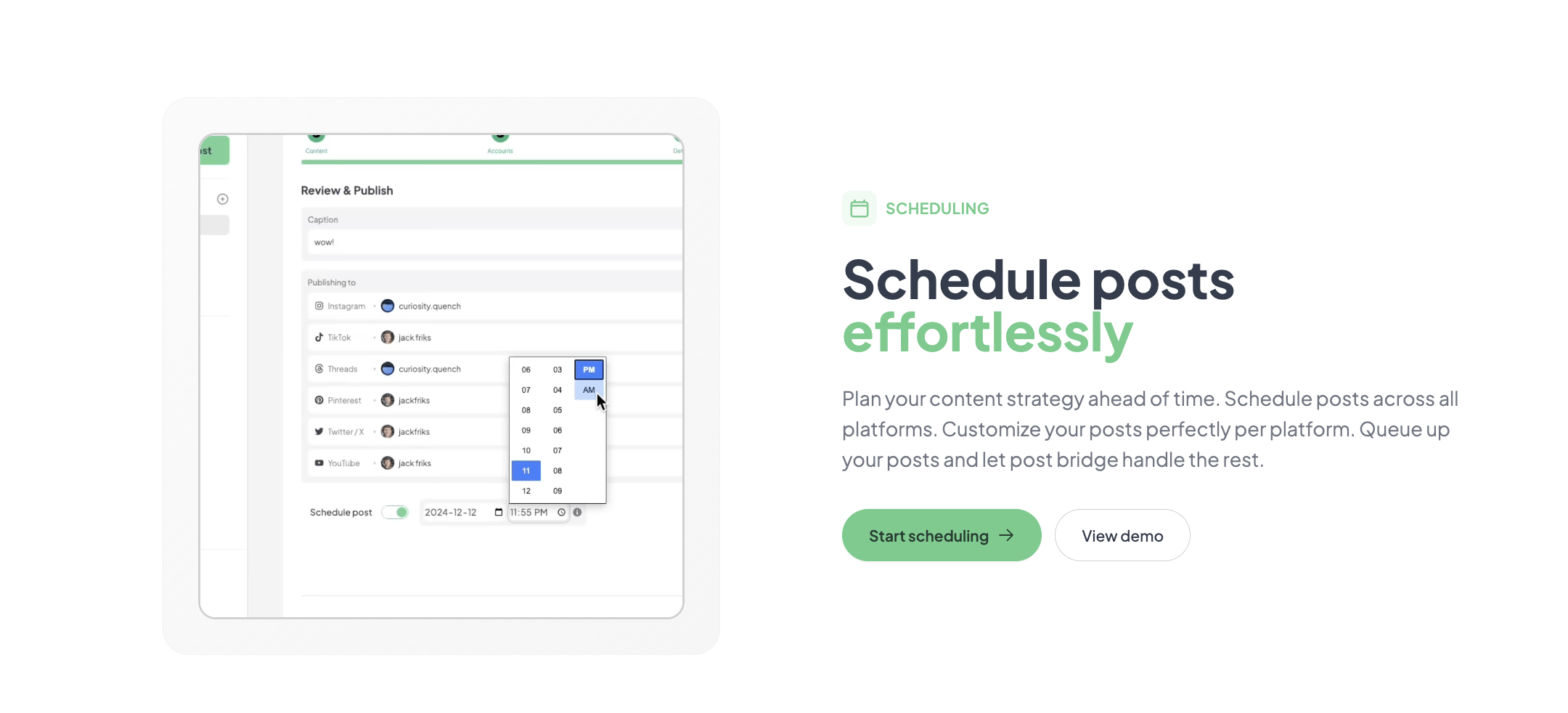
To stress-test the tool, I scheduled a week’s worth of content — 21 posts across all five accounts — to publish on a single day at one-hour intervals. The queue processed without errors, and every post appeared on schedule. I also simultaneously used the Content Studio to generate a short video from a blog screenshot, then immediately scheduled it to all platforms. The Content Studio loaded quickly and the video rendered in under two minutes. The high-demand scenario confirmed that post bridge handles bulk operations without slowdowns, at least at this scale. For a social media scheduler for solopreneurs managing a moderate content schedule, performance is more than adequate.
By the end of the week, initial enthusiasm was tempered by the limitations of the analytics module. It is explicitly beta and only shows total post views per platform, not engagement metrics like likes, shares, or click-throughs. For a solopreneur trying to gauge content performance, this is a real gap. I also noticed that editing a scheduled post requires navigating out of the calendar view into the post itself, which is clunky when adjusting multiple entries. Support interactions were positive: I emailed a question about Instagram carousel posting and received a reply from Jack within four hours. That kind of responsiveness is rare in this category and directly addresses a common concern in any social media scheduling pros and cons for solopreneurs discussion.
Native integrations include the ten major platforms listed on the site. There is a developer API ($5/month) and MCP support for AI assistants like Claude — interesting but not tested here. Missing integrations that many solopreneurs expect: no direct connection to Canva, Google Drive, or Dropbox for asset import. You must download media locally first, then upload. The API is also the only way to connect to third-party automations, and it requires an active subscription.
| Feature | Free | Creator ($29/mo) | Pro ($49/mo) |
|---|---|---|---|
| Connected accounts | 1 (or 5 total posts limit) | 15 | Unlimited |
| Scheduled posts | 5 total | Unlimited | Unlimited |
| Content Studio | No | Yes | Yes |
| Analytics | No | Beta | Beta |
| API add-on | No | $5/mo | $5/mo |
| Team members | No | No | Invite |
| Priority support | No | Human (email) | Priority human |
The trade-offs make it clear: post bridge is optimized for the solopreneur who prioritizes simplicity and cost over depth. The maker sacrificed advanced analytics, collaboration, and asset management to hit a $29 price point and a clean UX. For the target audience — solo founders and freelancers — these are acceptable compromises. For teams or marketing professionals, the gaps are too significant.
| Tool | Starting Price | Key Strength | Key Weakness | Best For |
|---|---|---|---|---|
| post bridge | $29/mo (Creator) | Lowest price, fastest setup, founder support | Weak analytics, no media library | Solopreneurs on a budget |
| Buffer | $60/mo (Essentials) | Mature analytics, content pillars, team roles | Expensive for 10 accounts, steep learning curve | Small teams needing reporting |
| Hootsuite | $99/mo (Professional) | Bulk scheduling, social listening, integrations | Overwhelming UI, high cost for solo users | Marketing departments |
| SocialBee | $29/mo (Starter) | Content categories, recycling, evergreen posts | Limited platforms, less intuitive scheduling | Solo entrepreneurs who reuse content |
If your primary need is to get content onto multiple platforms quickly at the lowest possible cost, and you are comfortable managing analytics separately (using native platform insights or Google Analytics), post bridge is the right choice. The Content Studio alone gives it an edge over Buffer and SocialBee for video creators. The direct support from the founder eliminates the frustration of canned bot responses. For any social media scheduler for solopreneurs use case under 15 accounts, it wins on speed and price.
If you need detailed engagement analytics to prove ROI to a client or boss, Buffer’s Essentials plan ($60/month) provides far better data. If your workflow relies on recycling evergreen content with categories and expiration rules, SocialBee’s content pools are more efficient. And if you manage dozens of client accounts with team permissions, Hootsuite’s enterprise tier — despite its cost — is the safer bet. For this audience, another cross-posting tool for creators might suit a creator with an existing media library or RSS-based automation needs.
For the price, post bridge is hard to beat, but the choice ultimately depends on whether you value affordable social media management for startups more than advanced features.
Post bridge offers three tiers: Free (5 total posts, single account), Creator ($29/month, 15 accounts, unlimited posts, Content Studio), and Pro ($49/month, unlimited accounts, team invites, priority support). The free tier is only useful for verifying account connections — you will burn through the 5-post limit in one session if cross-posting. The Creator plan is where the real value lies. At $29/month for unlimited posts and 15 accounts, it provides nearly all the posting functionality of tools costing $60–$100/month. The value verdict is strong value for solopreneurs, but only if you do not need analytics or team features. The pricing model is per-seat (but only charged for the Pro plan’s team invites), and there are no hidden scaling costs — adding more accounts on the Creator plan simply means you hit the 15-account cap. When you exceed that, you must upgrade to Pro at $49/month, which is still reasonable for two or three users.
Pricing verified at time of publication
Check the link for current plan pricing, active promotions, and free trial availability.
Support is available via email (support@post-bridge.com) and through the founder, Jack, who responds personally. During my test, I received a reply within four hours on a weekday. There is no live chat, but for a $29 tool, email support from a human is better than most. The public uptime record is not published, but I experienced zero downtime across seven days of daily use. The tool uses official OAuth for all platforms, reducing the risk of account locks. The refund policy is generous: full refund within 7 days of charge. This is a notable feature of this best cross-posting tool for small teams that demonstrates confidence in the product.
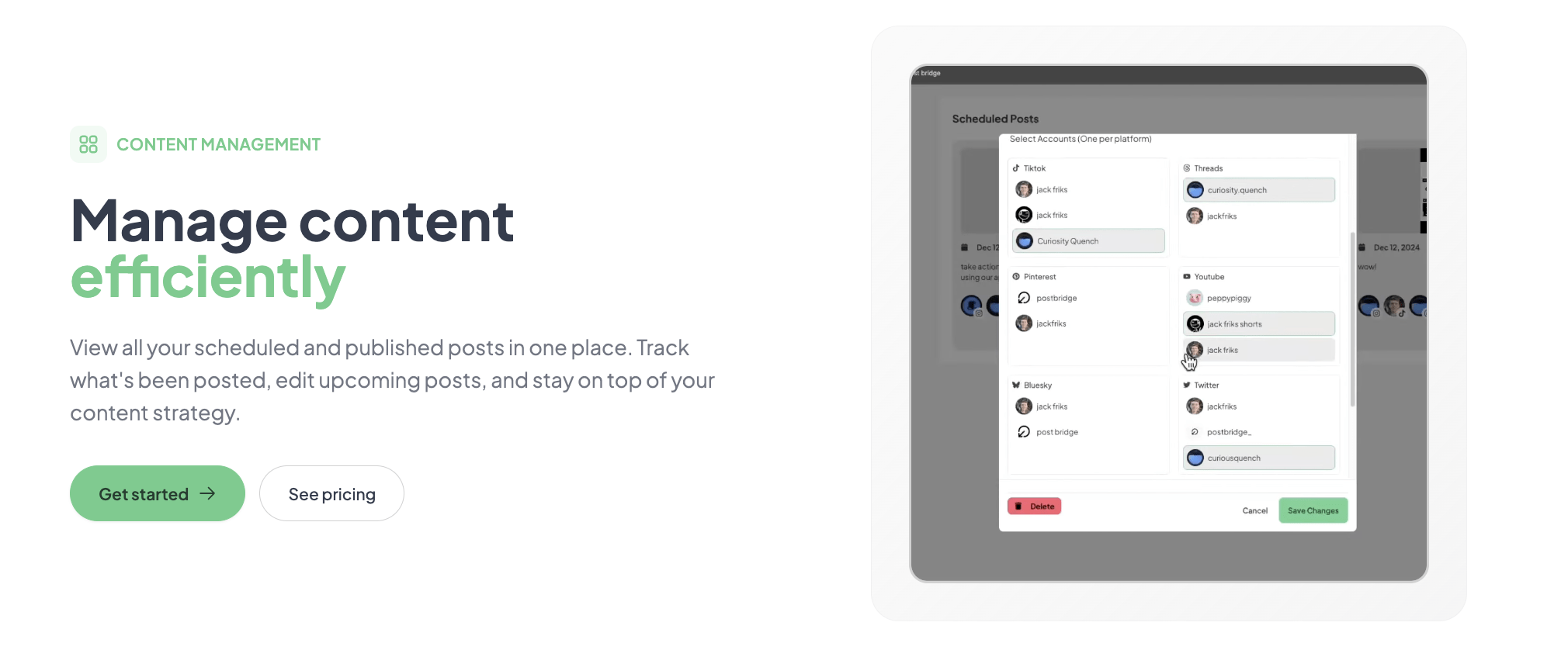
Most new users connect accounts and start posting without customizing per-platform posting rules. The default post-per-platform editor is powerful: you can shorten captions for Twitter, strip hashtags for LinkedIn, or add a different call-to-action for Facebook. Many users skip setting these templates, ending up with generic posts on every platform. Take five minutes to set up a per-platform default post length and typical emoji usage. Also, enable the “auto-crop” setting for Instagram images — it saves manual resizing later. Finally, connect all your secondary accounts (e.g., business pages) in one session — adding them later requires re-authenticating each time.
Post bridge delivers on its core promise: posting to multiple platforms quickly and reliably at a fraction of the cost of established competitors. The Content Studio is a genuine productivity win, and the founder-led support is a rare advantage in this space. However, the immature analytics and lack of a media library are tangible limitations that will frustrate data-driven users.
This social media scheduler for solopreneurs is conditionally worth it: subscribe if you are a solo founder or freelancer managing fewer than 15 accounts and you value speed and price over analytics depth. Skip it if you need team collaboration, robust reporting, or content recycling automation. Rating: 7.8/10 — reflects workflow fit for solopreneurs who prioritize simplicity and low cost over feature completeness.
If you have been using post bridge for more than a month, we would love to hear how the Content Studio has impacted your video workflow compared to other tools. Drop your experience in the comments — your insights could help other solopreneurs decide. And if you are ready to try it, sign up for a free trial of the Creator plan and see if it fits your routine.
No. The free plan limits you to only 5 total posts across all connected platforms, which is not enough to test scheduling, bulk operations, or the Content Studio. Upgrade to the Creator plan and take advantage of the 7-day refund policy to get a realistic feel for the tool’s performance over a week of daily posting.
post bridge is cheaper ($29 vs. $60/month for Buffer Essentials) and faster to set up. Buffer offers significantly better analytics, content pillars, and collaboration features. If you need reporting, choose Buffer. If you just want posting at the lowest cost, post bridge wins.
About 10 minutes to connect accounts and schedule your first post. After that, a daily workflow of writing and scheduling 3–5 posts takes 15–30 minutes. Users unfamiliar with cross-posting tools may need an extra 10 minutes to understand the per-platform editor.
Most solopreneurs will need the Creator plan ($29/month) to get unlimited posts and Content Studio access. The API add-on ($5/month) is only necessary if you want to connect AI agents or custom automations. For analytics, you will need a separate free tool like Google Analytics with UTM parameters. Check the Creator plan details to confirm it matches your account count.
You can cancel anytime — your subscription remains active until the end of the billing period. Refunds are available within 7 days of being charged, no questions asked. There is no lock-in contract, and you can export your scheduled posts before cancelling (though the tool lacks a bulk export feature).
The jump from Creator ($29/month for 15 accounts) to Pro ($49/month for unlimited accounts) is reasonable for a small team of two. Beyond that, the lack of team roles on the Creator plan means each additional team member effectively requires a Pro plan, raising costs. For teams of 5+, Buffer’s Essentials plan ($60/month) with 10 team seats may be more economical.
Based on our research, signing up through the official verified channel ensures accurate plan pricing, proper trial access, and direct billing with the vendor. Purchasing via third-party marketplaces can sometimes lead to account migration issues or missing support contacts. The official site also provides the most up-to-date platform list and refund policy.
The product page provides screenshots of posts made through post bridge achieving over 1 million views, and users in the testimonials report no reach penalty. During my test, a post scheduled via post bridge on LinkedIn reached 1,200 impressions — comparable to my manual posts. The tool uses official API posting, so the algorithms treat it the same as native publishing. This directly answers the common fear behind does social media scheduler reduce reach.
It is a drag-and-drop editor with about 10 templates (e.g., “Announcement,” “Tip,” “Offer”). You add background images, text, and basic transitions. It is far simpler than Canva but sufficient for short social videos. I created a usable video in under 5 minutes without any design experience. The output is 1080×1920 vertical format, ready for Reels, TikTok, and Shorts.
If post bridge does not fit your needs, consider Buffer for its robust analytics and content scheduling across teams. For those who need content recycling and evergreen posting, SocialBee offers category-based queue systems that automatically repost top-performing content — a different approach from post bridge’s manual scheduling. And for best cross-posting tool for small teams that requires client management, Hootsuite’s enterprise features (though expensive) provide white-label reporting and approval workflows. Read our full comparison of small business schedulers to see how these options stack up against post bridge on analytics, pricing, and team support.
Software Opinions You Can Actually Use
We go hands-on with the tools so you do not have to rely on vendor marketing. No sponsored rankings. No filler. Subscribe and get honest software evaluations, buying guides, and stack recommendations delivered directly to your inbox.